Klaviyo email done for you, checked against what sent
Email is the channel a store owns outright, and the one most likely to be quietly broken while every dashboard calls it live.
The short answer
A Klaviyo expert builds and fixes the automatic emails that sell for a Shopify store. Klaviyo calls them flows, such as welcome, abandoned cart, browse abandonment and post-purchase. Then the expert checks that they actually send and counts the orders in Shopify, not only in Klaviyo. The most common failure is a flow that says live and reaches almost nobody.
Works remotely with US stores. I log into your Shopify, Klaviyo and Google accounts from here, wherever you are in the US, so there is no office visit and no local market limit.
What does a Klaviyo expert do for a Shopify store?
Checks what is really sending. Compares how many emails each flow sent with the number of people it was built to reach.
Fixes triggers. A trigger is what starts a flow, and some are set up so they never reach the people the flow was built for.
Builds the core flows. Welcome, abandoned cart, browse abandonment, post-purchase and win-back.
Grows who email can reach. Sign-up forms and capture where visitors actually land.
Sends campaigns. A steady schedule to the full list, not a burst every few months.
Reports honestly. The sales Klaviyo credits to email, shown next to the orders Shopify ties to email clicks.
What is done for you, and what stays with you?
Done for you
Stays with you
Checking every flow's sends against list size
Ownership of the Klaviyo account and its billing
Fixing triggers and filters, and building the core flows
Decisions on discounts and offers, because they are margin decisions
Placing sign-up forms where visitors land
The facts about your products and policies
Writing and scheduling campaigns to the full list
Approving what goes out under your name
A monthly report with Klaviyo's numbers next to Shopify's
Customer replies and customer service
What exactly does Klaviyo do?
Klaviyo is an email and SMS marketing platform built for online stores. It connects to Shopify, records what shoppers do on the site, and sends automated flows and scheduled campaigns based on that activity.
What is the one minute check?
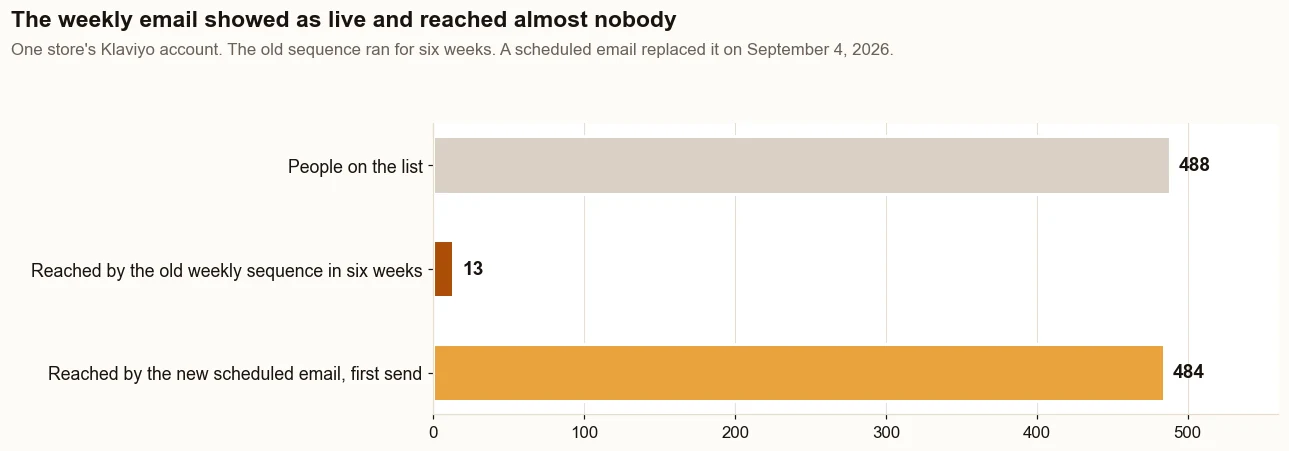
Compare sends against list size for every flow. On the store in the case study, a weekly email sequence built for 488 people showed as live for six weeks and reached 13 people. A sequence that size should send thousands in a quarter.
Why do flows say live and send nothing?
The flow used the Added to List trigger, which only starts the flow for people added to the list after the flow is switched on. The list was built first, so almost nobody entered the flow.
It was replaced on September 4, 2026 with a scheduled weekly email that reached 484 people on its first send, September 8. Sales from email went from $987 in the 30 days before the work began to $4,308 in the 30 days about three months in, by Shopify's own reports.
The weekly sequence reached 13 people in six weeks while it showed as live. The scheduled email that replaced it reached 484 on its first send. Source: the store’s Klaviyo account.
Why does capture come before copy?
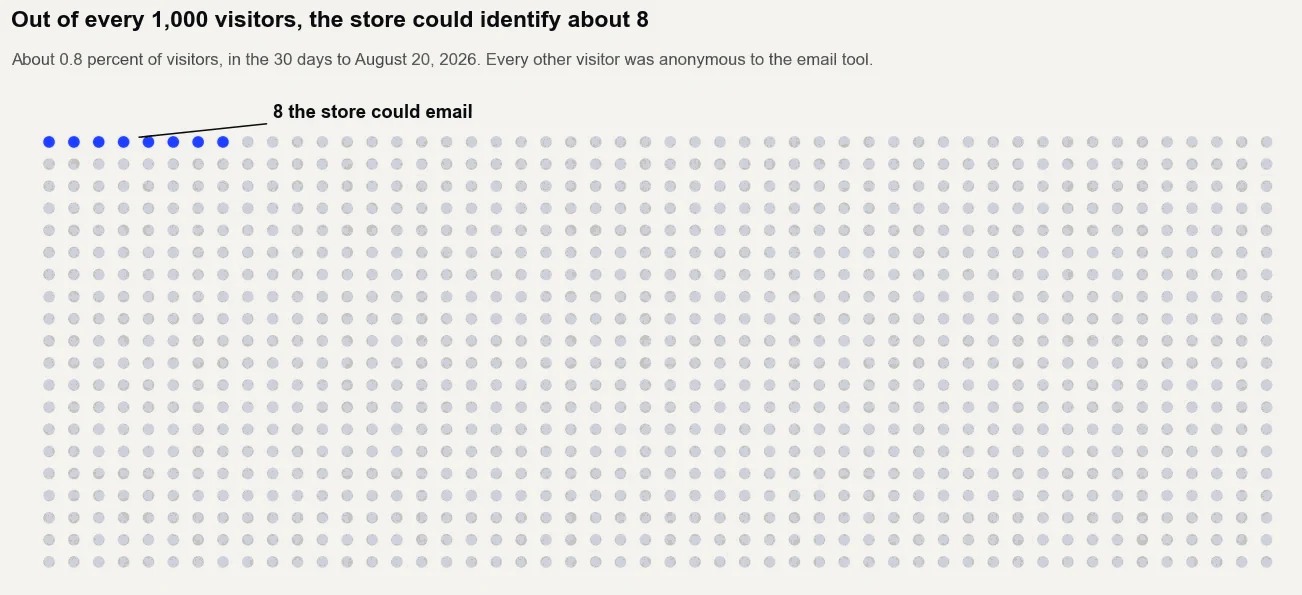
Browse abandonment on that store looked broken at zero orders. It really had almost nobody to send to. The store could identify only about 0.8 percent of its visitors.
And with 33 of the 41 people who started checkout finishing, the abandoned cart pool was eight people a month, in the 30 days to August 20, 2026. Neither was a subject line problem.
About 8 in every 1,000 visitors could be emailed, in the 30 days to August 20, 2026. Source: Klaviyo’s Active on Site metric against Shopify sessions.
Which flows matter most, and what does each need?
Flow
Starts when
What it needs to work
Welcome
Someone subscribes
A sign-up form people actually see
Abandoned cart
An identified shopper leaves a cart or checkout
Shoppers who reach the cart and give an email
Browse abandonment
An identified shopper views a product and leaves
Onsite tracking and a healthy identification rate
Post-purchase
An order is placed
Accurate order data from Shopify
Win-back
A customer has not bought in a while
Enough order history to define a while
What should you read instead of open rate?
As a working rule, not a published figure, an open rate above roughly 50 percent includes automatic opens from Apple Mail, not just people opening emails. Apple explains how Mail Privacy Protection works, and Klaviyo shows how to identify Mail Privacy Protection opens. Judge email on clicks, revenue per recipient and orders.
Check Klaviyo's revenue against Shopify's Total sales by referrer report. Klaviyo's help center says it counts an order that comes within a set number of days after an open or a click, a period Klaviyo calls the attribution window. Automatic Apple Mail opens count too.
What should a monthly Klaviyo report show?
Column
Why it belongs there
Recipients per flow
Proves each flow is actually sending
Clicks
Shows people acting, which machine opens cannot fake
Orders Shopify ties to email clicks
The store's own record of what email produced
Klaviyo attributed revenue
Klaviyo's view, reported next to Shopify's, never alone
List growth and identified visitors
Shows whether the pool every flow draws on is growing
How do you fix a flow that is not sending?
Confirm the flow and each message in it are set to live, not draft or manual.
Read the trigger. A list trigger only fires for people added after the flow goes live.
Check the flow filters and message filters, which can quietly exclude most of the list.
Check that the people it should reach are subscribed and consented for email.
After any fix, compare sends with list size again a week later.
Klaviyo's help center has a full checklist for troubleshooting a flow.
What should a Klaviyo expert do in the first 30 days?
Get a user login from you, and keep the account in your name.
Compare every live flow's sends with the number of people it should reach.
Check each trigger, and fix any flow that only catches people added after it went live.
Add the filter that stops reminders once someone buys.
Put sign-up forms on the pages that get traffic, starting with the best product pages.
Measure the share of visitors Klaviyo can identify, so there is a baseline.
Check the sending domain's authentication and the list's bounce, unsubscribe and spam rates.
Set up a monthly report that shows sends, clicks and revenue per recipient next to the orders Shopify ties to email clicks.
What does Klaviyo cost?
Klaviyo prices by the number of active profiles and the channels you use, and its pricing page lists current plans. According to Klaviyo's help center, it bills on profiles that can still receive your marketing, so suppressed and unsubscribed profiles do not count. The bigger cost is usually a list you pay for that the flows never reach.
Why does Klaviyo get expensive?
Because the price rises with the number of active profiles, and a list can grow for years with people who never click or buy. Suppressing the profiles that no longer engage takes them out of the billed count. The expensive list is the one full of people the flows never reach.
How do you check a Klaviyo expert's claims?
Claim
What to ask for
Red flag
The flows are live
Recipients per flow for the last 30 days, next to the size of each list
The word live with no recipient counts
Email made this much
Orders Shopify’s Total sales by referrer report ties to email, for the same dates
Klaviyo’s attributed revenue on its own
The emails are working
Clicks and orders per send
Open rate as the headline number
The list is growing
New subscribers per month and where they came from
A list that grows while sends stay flat
Discounts drive the results
Orders from the same flow with and without the discount
A discount in every email
The proof, from one store
Straight from the case study, with the source and what it does not prove. See all five results.
Result 2 · Email
Sales from email: $987 to $4,308 in about 90 days
Before the work$987
→
About 90 days in$4,308
4.4x
Baseline: the 30 days before the work began
$987 from 7 orders that came in through an email, 11% of sales, May 5 to June 3, 2026.
The work: what changed
Built welcome, abandoned cart, browse abandonment, win-back and high-ticket follow-up emails in Klaviyo (live July 28). Found that the weekly email only went to people who joined the list after it was switched on, so it reached 13 people in six weeks. Replaced it with a scheduled weekly email (September 4) that reached 484 people on its first send (September 8).
Result: about three months in
$4,308 from 10 orders that came in through an email, 18% of sales, August 17 to September 15, 2026, 4.4 times the baseline.
Evidence source
Shopify Analytics, Total sales by referrer, Klaviyo row, pulled September 18, 2026.
What this does not prove
One deposit order, worth $2,080, was placed 17 minutes after the buyer clicked a welcome email. Without it, email brought in $2,228, still 2 times the baseline. Klaviyo credits email with more, 23 orders for the same dates, because it counts any order placed within days of someone opening or clicking an email.
Test it on your store
In Klaviyo, open each flow and compare recipients over the last 30 days with the size of the list it should reach. Then open Total sales by referrer in Shopify for the same 30 days and find the Klaviyo row. A flow reaching a fraction of its list, or a Klaviyo row near zero, is the place to start.
$2,500, one time, for the Klaviyo audit and fix. $1,500 a month for full Klaviyo email after that: one campaign email a week, written, built and sent, and every flow kept working.
What that is set against: on one store, sales from email went from $987 in the 30 days before the work began to $4,308 in the 30 days about three months in. The difference, $3,321, is more than the price of the fix. Elsewhere, one US Shopify agency lists a Klaviyo audit at $1,000 and a four-flow build at $2,500, and US agencies that publish a monthly price start between $1,200 and $4,400 a month. See every price and its sources.
What changes when this works?
The emails your store sends on its own reach the people they were built for, and email brings in orders without a bill attached. Or leave the list idle, and keep paying for orders your own store could have sent.
Straight answers
Questions about this.
Klaviyo agency or Klaviyo expert: which do I need?
If your flows are built but not earning, you need someone who reads what actually sent and fixes it. I check three flows first: welcome, abandoned cart and browse abandonment. On one store, the weekly email had reached 13 people in six weeks; the scheduled email that replaced it reached 484 people on its first send. That is what I do as a one-person Klaviyo agency.
Is Klaviyo worth it for a Shopify store?
Yes, if the flows actually send. The common failure is not the platform, it is a flow reporting live while sending almost nothing. Check sends against list size first.
What is a good email open rate for a Shopify store?
Open rate is no longer a usable measure. Apple Mail Privacy Protection records machine opens, so, as a working rule, anything above roughly 50 percent is mostly machines. Use clicks, revenue per recipient and orders.
Why is my Shopify abandoned cart email not producing sales?
Usually because almost nobody is eligible. Count the people who start checkout and do not finish. On one store with about 7,500 sessions a month, that pool was eight people in 30 days.
What exactly does Klaviyo do?
It is an email and SMS marketing platform for online stores. It connects to Shopify, tracks what shoppers do on the site and sends automated flows and scheduled campaigns based on that activity.
How much does Klaviyo cost per month?
It depends on how many contacts you have and which channels you use. Klaviyo's pricing page lists current plans. Check that the contacts you pay for are ones your flows can actually reach.
Should I trust Klaviyo's revenue numbers?
Treat them as Klaviyo's view, not the store's record. Klaviyo credits orders placed within its attribution window after an open or click, including automatic Apple Mail opens. Compare them with the orders Shopify's Total sales by referrer report ties to email.
Who is a good Klaviyo expert for a Shopify store?
Someone who judges flows by sends against list size and by the orders Shopify ties to email, not by the word live or by open rate, and who works inside your own account so you keep it.
What's cheaper than Klaviyo?
Shopify Messaging, Shopify's built-in email, sends up to 10,000 emails a month free and then charges $1 per 1,000, according to Shopify's pricing page in September 2026. Switching rarely fixes a flow that never sends, so check sends against list size before you move.