Is your 92 percent email open rate real?
238 opens on 263 sends. The number was machine generated, and it was the most flattering figure on the screen. Here is what to trust instead, and what it means when an open rate suddenly drops.
Probably not. Apple Mail Privacy Protection loads email images automatically, which records an open whether or not anyone read the message, and Klaviyo says it cannot tell those machine opens from human ones. As a working rule, an open rate above roughly 50 percent is mostly machines. Judge email on clicks and orders instead.
What did the account actually show?
One store's email account showed a 92 percent open rate on its list engagement screen. Underneath were 238 opens on 263 sends across the whole account in the 30 days to August 20, 2026, which works out to about 90 percent. It was the most flattering number on the screen, and machines produced most of it.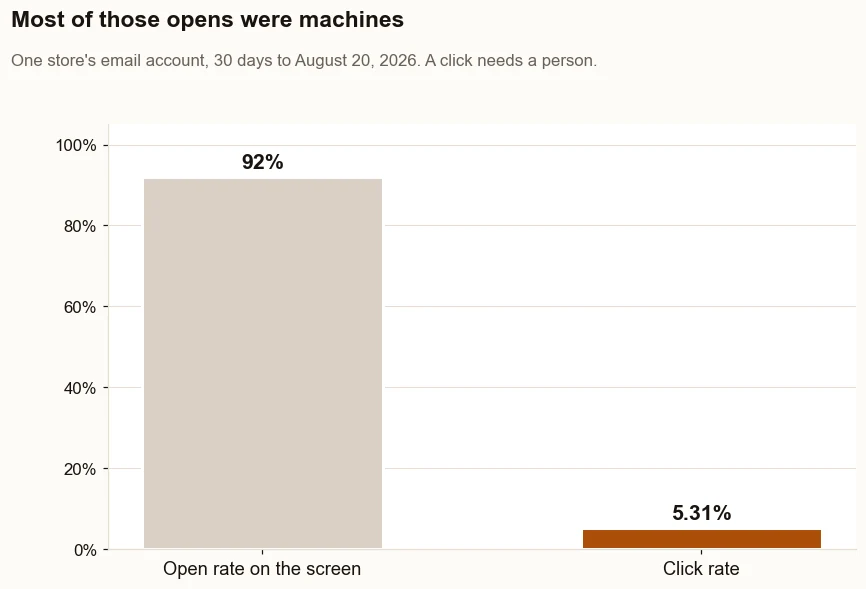
How is email open rate calculated?
Klaviyo’s analytics glossary defines open rate as the number of people who opened an email divided by the number of recipients. Each person counts once, however many times they open it.
That is why one machine open per Apple Mail reader is enough to inflate it. The open count fills up with devices, not readers.
What is Apple Mail Privacy Protection?
Mail Privacy Protection is an Apple Mail setting. According to Apple, when it is on, remote content is downloaded privately in the background when a message arrives instead of when it is viewed, and the reader's IP address is hidden from senders. Email platforms count an open when a tiny tracking image loads, so the message can register as opened before a person ever sees it.
When did Mail Privacy Protection start, and who does it affect?
Apple introduced it in 2021 with iOS 15. It works inside the Apple Mail app, so it affects anyone who reads email there with the setting on, whatever email address they use. Someone reading a Gmail address in the Apple Mail app can trigger machine opens. Someone reading the same address in the Gmail app does not.
That is also why an open rate from before 2021 cannot be compared with one from today.
Why does it inflate open rates?
Klaviyo's help center says that with Mail Privacy Protection on, the images in a message load whether or not the recipient opens it, which records a false open, and that there is no way to tell a human open from an automated one. On a small list with many Apple Mail readers, those machine opens can push an open rate close to 100 percent.
What is a good email open rate now?
No single number is reliable anymore, because nobody can say how many of a list's opens are machines. As a working rule, an open rate above roughly 50 percent is mostly Apple Mail machine opens. Open rate is only useful for comparing sends to the same list over time, not for deciding whether email works.
For the numbers that do hold up, see how to measure email marketing results honestly.
Is a 25 or 35 percent open rate good?
It depends on how many of those opens are machines, and the open rate cannot tell you. Two lists with the same 35 percent open rate can have completely different sales. Look at clicks and orders from the same send before you decide.
Is a 15 percent open rate bad?
Not necessarily. A lower open rate can simply mean fewer Apple Mail readers on the list, not fewer people reading. Look at clicks and orders from the same sends before deciding anything, and compare the list with its own past sends rather than with another store's.
What does a sudden drop in open rate mean?
Treat it as a delivery warning before you treat it as a writing problem. Comparing sends to the same list over time is the one job open rate still does well, and a sudden fall is exactly what it can flag. Watching the number slide week after week is unsettling, especially when email brings in a big share of your sales.
Klaviyo’s deliverability guide lists a drop in opens among the common symptoms of a deliverability issue, alongside a drop in clicks and spikes in bounces, unsubscribes and spam complaints. It suggests tracking open rates with Apple’s machine opens taken out, over time, and asking what else changed. Four questions narrow it down:
- Did clicks fall too? If clicks and orders held steady, the drop is less urgent than it looks.
- Is it one inbox provider? Klaviyo’s deliverability FAQ says that when open rates suffer only for one inbox provider or email domain, you can work on your sender reputation with that group.
- Did you just switch platforms? Klaviyo says any new sender must warm up when moving to a new email service provider, and that opens and clicks can fluctuate for up to about 120 days while its reputation is validated. What switching email platforms really costs covers the rest of the move.
- Are you mailing people who never engage? The same FAQ calls suppressing profiles that have never engaged the best first step for low open rates.
A very low rate, the kind that makes the email bill feel wasted, points the same way: check inbox placement and list health before you touch a subject line.
What should you track instead of open rate?
| Metric | What it tells you | Inflated by Mail Privacy Protection? |
|---|---|---|
| Open rate | An image loaded | Yes, heavily |
| Click rate | Someone acted on the email | No, though security scanners can add bot clicks |
| Revenue per recipient | What each person on the send was worth | No |
| Orders in Shopify's Total sales by referrer report | Orders that arrived from an email click | No |
On the same account, the click rate was 5.31 percent and the average order value was $359.43. Both held up. Neither was as pleasant to put in a report.
The flows worth measuring this way are in the Klaviyo flows guide, and how two platforms count results is in Klaviyo vs Mailchimp.
What is a good click rate?
Klaviyo's own audit guide suggests an average campaign click rate of 1 percent or higher, and it notes that open rates have been unreliable since Apple's iOS 15 update. A click needs a person to act, so Apple's automatic opens cannot inflate it. On the account above, the click rate was 5.31 percent.
Clicks are not spotless either, because security software can click links. Klaviyo’s attribution settings can remove those bot clicks from reporting, and they do by default for new accounts.
What affects the opens that are real?
Apple's automatic opens aside, a handful of things decide whether a person opens an email:
- Who it is from: a sender name people recognize.
- The subject line, and the preview text that shows after it.
- Whether it reaches the inbox at all, which depends on authentication and on spam complaints.
- Whether the person still wants your email. Someone who signed up long ago and never clicks is less likely to open.
- When it arrives, compared with when your buyers read email.
Each of these is better judged by clicks and orders than by opens.
How do you improve engagement without chasing opens?
- Authenticate the sending domain with SPF, DKIM and DMARC, so inboxes trust your mail.
- Send most campaigns to people who have clicked or bought recently.
- Stop mailing people who have not clicked or bought in a long time, before they start marking you as spam.
- Test subject lines on clicks and orders.
- Put one clear link near the top of the email, so the reader who is interested can act.
People you stop mailing still count toward a Klaviyo bill until they are suppressed. How to lower your Klaviyo bill without losing sales covers that cleanup.
How do you calculate revenue per recipient?
Divide the revenue a send produced by the number of people it was sent to. Klaviyo shows it in its reports, using its own rules for which orders it credits to email.
For a number the email platform did not grade itself, use Shopify. Take the sales Shopify's Total sales by referrer report ties to email for the same dates, and divide them by the same number of recipients. Report both, and say which is which.
Why the two numbers differ is covered in why Klaviyo claims more sales than Shopify.
Is click-to-open rate a better measure?
Not much. Click-to-open rate divides clicks by opens. Machine opens pad the number of opens, so they drag the rate down on lists with many Apple Mail readers.
Click rate, which Klaviyo’s glossary defines as the share of recipients who clicked, does not depend on opens at all. That makes it the cleaner number to watch.
How do you find machine opens in Klaviyo?
Klaviyo can show Apple privacy opens as their own numbers in a custom report, using its Apple Privacy Opens properties. That tells you how much of an open rate came from devices with Mail Privacy Protection on. It still cannot tell you which of those opens a person made, so treat the rest of the open rate as an upper limit, not a count of readers.
Why does this matter for segments and flows?
Anything built on opens inherits the machine opens. A segment of people who opened in the last 90 days can be full of people who never read an email, and Klaviyo's help center recommends building engagement segments with both open and click filters. Sending more email to people who only look engaged is how a list quietly stops reaching real inboxes.
The same goes for a sunset flow, which retires people who have stopped engaging. Apple Mail readers who never read can keep looking engaged, so a sunset flow built on opens alone may never reach them.
How do you build an engaged segment without trusting opens?
Build it on actions a machine cannot take. In Klaviyo's segment builder, for example, include people who:
- clicked an email at least once in the last 90 days, or
- placed an order at least once in the last 180 days, or
- were active on the site at least once in the last 30 days.
The time windows are a starting point, not a rule. Set them from how often your customers actually buy.
Can you still test subject lines?
Not on open rate alone. When a large share of opens are automatic, the subject line with the higher open rate may simply have gone to more Apple Mail readers. Judge a subject line test on clicks and orders from each version, and give it enough sends to see a real difference.
The same rule applies to the biggest sends of the year; the Black Friday guide tests Black Friday email subject lines on clicks and orders too.
How do you check a number before you report it?
Ask what would have to be true for it to be wrong. Open rate fails that test, because a machine can produce it. Click rate, revenue per recipient and Shopify's Total sales by referrer report pass it, because each one needs a person to act.
- Apple Support: Use Mail Privacy Protection on iPhone
- Klaviyo Help Center: How to identify iOS 15 Mail Privacy Protection opens
- Klaviyo Help Center: Custom reports to track Apple Mail Privacy Protection opens
- Klaviyo Help Center: Understanding message conversion tracking
- Klaviyo Help Center: Analytics glossary
- Klaviyo: How to audit your email marketing
- Klaviyo Help Center: How to change your attribution model
- Klaviyo Help Center: Getting started with email deliverability monitoring and performance metrics
- Klaviyo Help Center: Email deliverability FAQs
- Klaviyo Help Center: Understanding email deliverability
- Klaviyo Help Center: How Klaviyo billing works
Does this sound like your store?
If it does, the service that fixes it is Klaviyo email, done for you. You can see the before and after on one store in the case study.
Questions about this.
What is a good email open rate now?
Open rate is no longer a reliable measure. Apple Mail Privacy Protection loads images automatically and records opens nobody made, so an open rate above roughly 50 percent is mostly machines. Judge email on clicks, revenue per recipient and orders.
Why is my email open rate so high?
Usually Apple Mail Privacy Protection, which pre-fetches images and registers an open whether or not a person looked. One account's screen showed a 92 percent open rate, with 238 opens on 263 sends.
What should I track instead of email open rate?
Clicks, revenue per recipient and orders. On the same account, a 5.31 percent click rate and a $359.43 average order value held up.
Is a 35 percent email open rate good?
The open rate alone cannot say, because Apple Mail Privacy Protection records machine opens that look identical to human ones. Compare clicks and orders from the same send, and use open rate only to compare sends to the same list over time.
Can Klaviyo filter out Apple Mail machine opens?
Klaviyo can report Apple privacy opens separately in a custom report, but its help center says it cannot tell a true human open from an automated one when Mail Privacy Protection is on.
Does Apple Mail Privacy Protection affect Gmail users?
It affects anyone reading email in the Apple Mail app with the setting on, including people who use a Gmail or Outlook address in that app. People reading in the Gmail app are not affected by it.
Can I exclude Apple opens in Klaviyo's settings?
Only from attribution. Klaviyo's attribution settings can stop Apple Mail Privacy Protection opens from earning email credit for a sale, but its help center notes this does not remove them from reporting, so the open rate on screen stays the same. A custom report or the Apple Privacy Open filter in a segment separates them.
Why did my open rate suddenly drop?
Treat it as a delivery warning first. Klaviyo lists a drop in opens among the common symptoms of a deliverability problem. Check whether clicks fell too, whether one inbox provider is affected, and whether you recently switched platforms: Klaviyo says opens and clicks can fluctuate for up to about 120 days while a new sender's reputation is validated.