Home / Insights / Email marketing for small business: what earns orders
Email · 13 min read
Email marketing for small business: what earns orders
You have a list, a tool and a few emails going out, and little to show for it in the bank. Here is what a small online store should send first, what it costs, and how to prove it works.
The short answer
Email marketing for small business earns orders when four automatic emails run first: welcome, abandoned cart, post-purchase and win-back, the order Klaviyo's own guide recommends. Add one regular campaign to the whole list. Then judge it by orders in Shopify's own reports, not by open rates, which machines inflate.
Is email marketing still worth it for a small business in 2026?
Yes, when you measure it in orders. Email marketing for small business works because it reaches people who already know your store, on a list you control, at almost no cost per message.
Marketers still report strong returns from it. In Litmus's 2025 State of Email survey of nearly 500 marketing professionals, 35% of companies reported a return of $10 to $36 for every $1 spent. Litmus's ROI guide puts the average at $36.
Those are Litmus's figures, reported by marketers about their own programs, not a forecast for your store. For small businesses, the better news is that email results are easy to check in your own reports.
Your own numbers are the ones that count. On one direct to consumer store on Shopify, sales from email in Shopify's referring channel report were $987 (11% of sales) in the 30 days before the work began (May 5 to June 3, 2026). In the 30 days about three months in (August 17 to September 15, 2026), they were $4,308 (18%).
One deposit order of $2,080 came 17 minutes after a welcome email click; without it, email was $2,228, still 2 times the start. It is one store, and its Facebook ads ran in both periods. The full story is in the case study.
“biggest barriers to growth, getting and retaining customers”
That is how the CEO of Intuit described what small and mid-market businesses struggle with when Intuit agreed to buy Mailchimp in 2021. Email is the channel built for the retaining half: people who already gave you their address.
What makes email marketing for ecommerce different?
Email marketing for ecommerce runs on your store's own customer data. Product views, carts, checkouts and orders can each start an email automatically, so the right message reaches a customer at the moment it matters.
There are two kinds of email. A campaign is one message you send to a list or segment.
A flow, as Klaviyo's flow guide defines it, is "a sequence of automated actions" triggered by a behavior or event, such as someone joining your list or checking out. Shopify's own tool, Shopify Messaging, calls them automations.
That data is what makes personalization possible. A personalized email names the product someone viewed or bought, not just their first name, so the content changes with what each customer did.
“We started Klaviyo with one goal in mind: to personalize at scale.”
For a small store, personalization at scale starts simpler than it sounds: send people emails about what they looked at or bought. A social media post goes to whoever the platform chooses to show it to. An email goes to the list you built.
Which emails should a small store set up first?
Four automatic emails, in this order: welcome, abandoned cart, post-purchase and win-back. That is the order Klaviyo's guide gives for the most impactful flows to set live first, and Shopify Messaging offers templates for each.
Flow
Starts when
What it does
1. Welcome series
Someone subscribes
Introduces your brand and turns subscribers into first-time customers
2. Abandoned cart
A shopper leaves products behind
Brings back would-be customers, based on what is in the cart
3. Post-purchase
Someone places an order
Thanks the customer and shows related products
4. Win-back
Time passes since the last order
Re-engages past customers who have not bought in a while
Keep each flow short at first, and add emails over time. Two or three emails that actually send beat nine that nobody receives.
How many people can your emails actually reach?
Only the people whose address you already have. Count that pool before you write a single subject line.
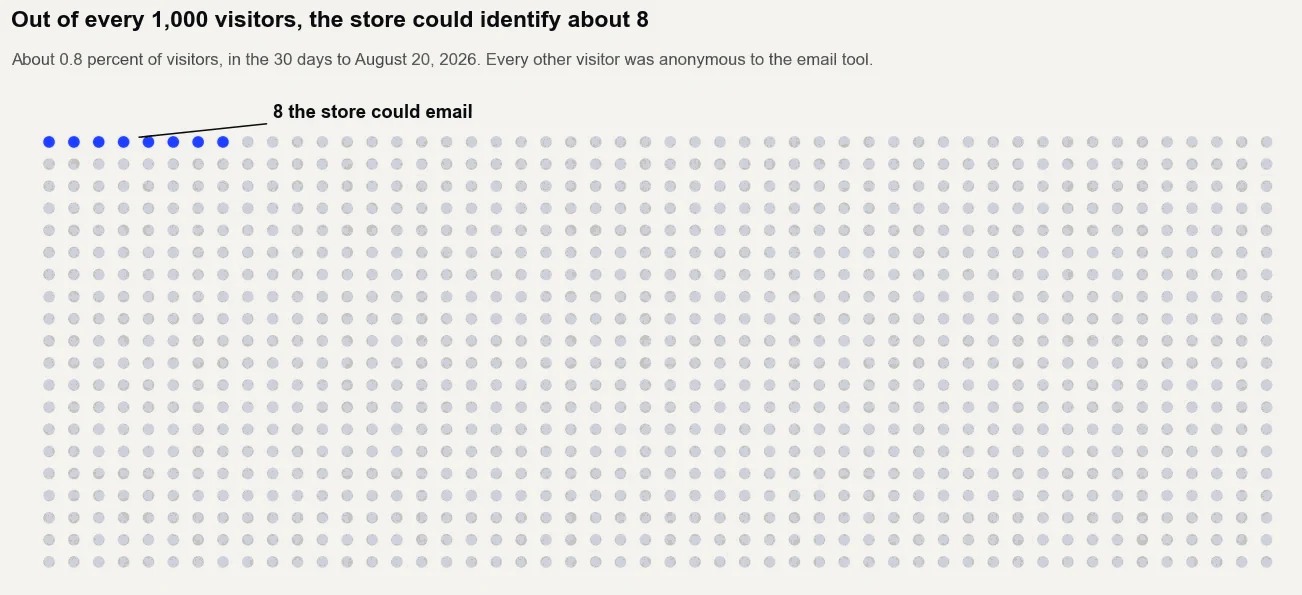
On one store doing about 7,500 sessions a month, 41 people started checkout and 33 finished over the 30 days to August 20, 2026. That left 8 people for the abandoned cart email. Over the same period, the store could identify, and so email, about 0.8 percent of its visitors.
About 8 in every 1,000 visitors could be emailed, in the 30 days to August 20, 2026. Source: Klaviyo’s Active on Site metric against Shopify sessions.
So the first job is building the list. Two doors matter most for a small store: sign-up forms and the checkout opt-in. Put a form on the pages that get traffic, including your best product pages.
Shopify suggests its Shopify Forms app for this, and Klaviyo's free plan includes web forms. Klaviyo's Shopify guide also shows how to add shoppers who accept email marketing through checkout.
What if visitors close your sign-up popup, even with a discount?
Then it is easy to decide nobody wants your emails. Before you believe that, or raise the discount, check when and where the popup appears.
Time it. Shopify Forms can show a popup on the first, second or third page view, at once or after a delay, and on desktop when a visitor moves to leave. Klaviyo’s form settings can wait for a time delay, a scroll depth, a number of pages viewed or exit intent.
Place it. Show it only on the page types where interest is high, such as product or collection pages, and choose desktop, mobile or both.
Keep it small. Google’s guidance on intrusive interstitials says they may frustrate visitors and erode their trust, and suggests small banners instead, including for newsletter sign-up prompts.
Give a reason that fits. Early access, restock alerts or a buying guide give people who are not ready to buy a reason to sign up.
A dismissed popup stays gone: Shopify Forms will not show it to that visitor again unless they clear their cache and cookies. Its teaser setting can show a small teaser that reopens the form when someone closes it without subscribing.
One regular campaign to your whole list, on a schedule you can keep. Automatic emails catch people at key moments; a campaign keeps everyone else hearing from you.
Schedule it, and check that it goes out. On the store in the case study, a weekly Klaviyo sequence built for 488 people showed as live for six weeks and reached 13 of them, because its trigger only caught people added after launch. A scheduled weekly email replaced it on September 4, 2026 and reached 484 people on its first send.
Good content for a small store is useful before it is promotional: how to choose or use a product, what is new or back in stock, answers to the questions customer service hears most, a review from a real buyer. Keep your brand voice the same in every email.
Plan your campaigns and content a month ahead, so a busy week never means a skipped send. The important part is the schedule. Always send yourself a test first.
What is the 80/20 rule in email marketing?
It is a rule of thumb, not a standard. A Constant Contact community post puts it as about 80% of emails that inform or entertain, and 20% that promote. Shopify's guide to the Pareto principle gives the sales version: a business might find 80% of its sales come from 20% of its customers.
Both are worth testing against your own Shopify reports rather than taking on trust.
What is the best email marketing platform for a small business?
For a small store on Shopify, the best tool is the one whose flows actually send and whose orders you can see in Shopify. Start cheap, and pay for more only when your emails need it and the orders show the value.
Several tools were made with small businesses in mind. Mailchimp's own history says its founders created an email marketing service for small businesses, and Klaviyo describes its free plan as best suited for small businesses and start-ups.
As of September 2026, according to each vendor's pricing page, here is where the common choices start:
A store sending mostly campaigns, such as weekly specials, can start on Shopify Messaging at no extra cost instead of paying for a big platform. A store whose sales ride on detailed behavior-based flows may need more than its templates. The side-by-sides are in Shopify Email or Klaviyo, Klaviyo alternatives, priced and what Klaviyo costs as you grow.
When checked on September 18, 2026, Mailchimp’s pricing page was also showing a first-year offer: 15 percent off these monthly prices for 12 months.
What rules apply before you send marketing emails?
Two sets: the law, and the inbox providers. In the United States, the FTC's CAN-SPAM guide says the law covers all commercial messages, not just bulk email, so it applies to small businesses too.
It also "makes no exception for business-to-business email". Its main requirements:
Accurate header information and subject lines that are not deceptive.
Your valid physical postal address in every message.
A clear way to opt out, with opt-outs honored within 10 business days.
Each separate email in violation can bring penalties of up to $53,088, according to the FTC. Other countries have their own rules. This is general information, not legal advice.
Inbox providers add their own. Since February 1, 2024, Gmail's sender guidelines require everyone sending to Gmail accounts to set up SPF or DKIM authentication, which proves the email really came from your domain, and to keep reported spam below 0.3%. Senders of more than 5,000 messages a day also need DMARC, a policy for mail that fails those checks, and one-click unsubscribe links.
“These practices should be considered basic email hygiene”
Hygiene sounds optional. It is not: a flow that lands in spam looks exactly like a flow that sends, until you check the orders.
How do you measure email marketing results honestly?
Count orders in Shopify, not the email tool's dashboard. Shopify's Total sales by referrer report shows sales by the site each customer came from, using the last interaction.
Email tools count differently. Klaviyo's conversion tracking guide counts an order after an open or a click inside its attribution window, the set number of days after an email when it still takes credit, including opens made automatically by Apple Mail Privacy Protection.
On the store in the case study, for August 17 to September 15, 2026, Klaviyo credited email with 23 orders. Shopify's report traced 10 to an email click. Both are defensible; they count differently, so report both.
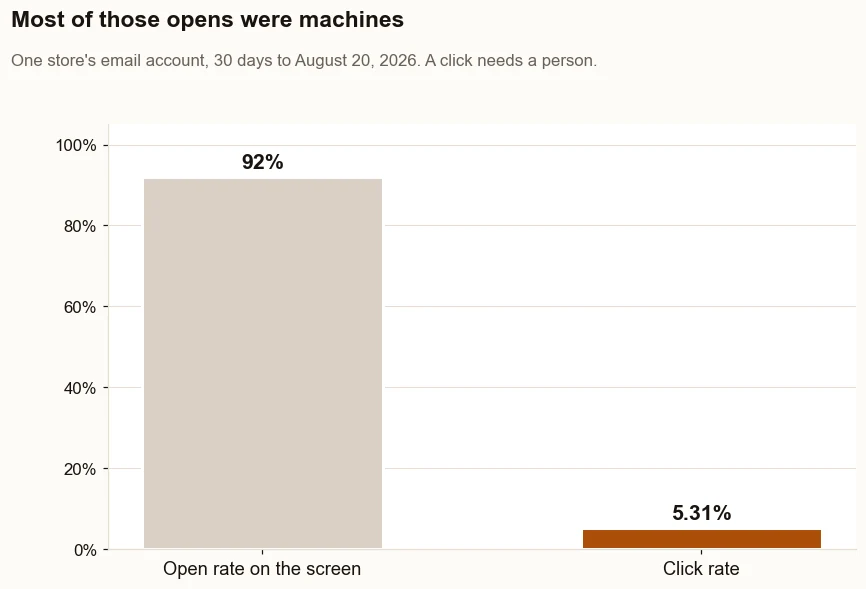
Open rates are the weakest number on the screen. The same account showed a 92 percent open rate over the 30 days to August 20, 2026; counted by sends, it was 238 opens on 263, about 90 percent. Its click rate was 5.31 percent.
The screen showed a 92 percent open rate. The click rate on the same account was 5.31 percent. Opens can be machines. Clicks need a person.
What does an ecommerce email marketing strategy look like, step by step?
A simple ecommerce email marketing strategy follows four steps, in order. Each one depends on the one before it.
Read the numbers side by side. Put Shopify's reports, Google and your email tool next to each other for the same 30 days, and find where sales leak.
Get names. Add sign-up forms where the traffic is, so you build a list of visitors you can email.
Get orders. Set live the four flows, then schedule weekly campaigns.
Show proof. Once a month, compare email orders in Shopify's Total sales by referrer report with the month before.
Those steps follow The Traffic to Sales Method. Keep the sending steady while you build: Shopify's sending guide advises a regular schedule, such as weekly, with similar volumes from send to send.
What mistakes cost small stores the most?
The quiet ones, because nothing on the dashboard looks broken. Watch for these:
A flow that says live and sends nothing. Check sends against the people who should qualify, every month.
Too few people on the list. If only a sliver of visitors can be emailed, every flow starves.
Judging by open rate. Machine opens make it look healthy when nobody reads.
Two tools sending the same email. Shopify warns that two similar automations send customers twice as many emails.
A discount in every email. It can teach every customer to wait for the next one.
Long gaps, then a big send. Shopify lists long gaps followed by large campaigns among the practices that can trigger blocks and delays.
What does email marketing for small business look like when it works?
It looks steady. New subscribers get a welcome series, carts get a reminder, buyers get a thank-you and a reason to come back, and the whole list hears from you on schedule.
Every month, Shopify's own report shows the orders email brought in, and you know which emails earned them. That is email marketing for small business done right: a channel you own, with content people want, earning orders you can see.
If your email is not there yet, the free Traffic to Sales Check reads Shopify, Google and email side by side to find the gaps. The fixes themselves are the work behind Klaviyo email, done for you.
The proof, from one store
Straight from the case study, with the source and what it does not prove. See all five results.
Result 2 · Email
Sales from email: $987 to $4,308 in about 90 days
Before the work$987
→
About 90 days in$4,308
4.4x
Baseline: the 30 days before the work began
$987 from 7 orders that came in through an email, 11% of sales, May 5 to June 3, 2026.
The work: what changed
Built welcome, abandoned cart, browse abandonment, win-back and high-ticket follow-up emails in Klaviyo (live July 28). Found that the weekly email only went to people who joined the list after it was switched on, so it reached 13 people in six weeks. Replaced it with a scheduled weekly email (September 4) that reached 484 people on its first send (September 8).
Result: about three months in
$4,308 from 10 orders that came in through an email, 18% of sales, August 17 to September 15, 2026, 4.4 times the baseline.
Evidence source
Shopify Analytics, Total sales by referrer, Klaviyo row, pulled September 18, 2026.
What this does not prove
One deposit order, worth $2,080, was placed 17 minutes after the buyer clicked a welcome email. Without it, email brought in $2,228, still 2 times the baseline. Klaviyo credits email with more, 23 orders for the same dates, because it counts any order placed within days of someone opening or clicking an email.
Test it on your store
In Klaviyo, open each flow and compare recipients over the last 30 days with the size of the list it should reach. Then open Total sales by referrer in Shopify for the same 30 days and find the Klaviyo row. A flow reaching a fraction of its list, or a Klaviyo row near zero, is the place to start.
What is the best email marketing for a small business?
For a small store on Shopify, the best choice is the tool whose flows actually send and whose orders show in Shopify's reports. As of September 2026, Shopify Messaging includes 10,000 free emails a month, and Klaviyo is free up to 250 active profiles, then $20 a month at 500.
Is email marketing still worth it in 2026?
Yes, if you measure it in orders. In Litmus's 2025 State of Email survey of nearly 500 marketing professionals, 35% of companies reported $10 to $36 back for every $1 spent. Those are marketers' own figures, so check yours in Shopify's Total sales by referrer report.
Is email worth it if most of your customers come from word of mouth?
Yes, for a different job. Word of mouth brings new buyers; email brings them back. Ask for the address at checkout and with a sign-up form, then let a thank-you email, a win-back email and a regular campaign keep you in touch. Judge it by the orders Shopify's reports tie to email, not by open rates.
What is the 80/20 rule in email marketing?
It is a rule of thumb, not a standard. One common version says about 80% of emails should inform or entertain and 20% should promote. A sales version, from Shopify's guide to the Pareto principle, says a business might find 80% of its sales come from 20% of its customers.
How much does email marketing cost for a small business?
Often nothing to start. As of September 2026, Shopify Messaging includes 10,000 free emails a month on a paid Shopify plan, then $1 per 1,000. Klaviyo, Omnisend and Mailchimp have free plans for about 250 contacts. Paid plans for 500 contacts start between $9 and $20 a month.
How often should a small business send marketing emails?
On a schedule you can keep. Shopify's sending guide advises a regular schedule, such as daily, weekly or bi-weekly, with similar volumes from send to send, and warns that long gaps followed by large sends can cause blocks and delays. Weekly is a good starting pace for a small store.
How far ahead should a small business promote a sale by email?
Announce it in your regular email before the sale starts, not in a sudden blast. Then send on launch day and once more before it ends. Shopify's sending guide lists five times your normal volume in one day, and long gaps followed by big campaigns, among practices that can get mail blocked or delayed.
Can I email my whole old list at once when I start?
No. Start with the people who opened or clicked recently, then grow volume 20 to 30 percent a week, as Shopify's warm-up guide advises. Leave out anyone who bounced, complained or unsubscribed, and hold back contacts whose opt-in you cannot confirm until your sender reputation is established.
How do small businesses get more email subscribers?
Put sign-up forms on the pages that get traffic, including the best product pages, and let customers opt in at checkout. Shopify points stores to its Shopify Forms app, Klaviyo's free plan includes web forms, and Klaviyo can add customers who accept email marketing at checkout.
Do small businesses need permission to send marketing emails?
The rules depend on the country. In the United States, the FTC's CAN-SPAM guide requires honest headers and subject lines, a postal address and an opt-out honored within 10 business days. Tools add rules too: Shopify Messaging automations send only to subscribed customers. This is not legal advice.