Post purchase emails that turn buyers into repeat customers
The first order cost you an ad click. The second one should not. Here is what to send after a purchase, when to send it, how many emails are too many, and how to see in Shopify whether it brought buyers back.
A post purchase email is any email a store sends after someone buys. Shopify already sends the order confirmation and shipping updates. The emails that bring buyers back are the ones you add: a thank-you, first-use tips, a review request and a cross-sell, timed to delivery and checked against repeat purchases in Shopify.
What is a post purchase email?
A post purchase email is any email a store sends after someone buys. Some are transactional: the order confirmation and shipping updates that tell the customer what happens next. The rest are marketing: a thank-you, tips for using the product, a request for reviews and a suggestion for what to buy next.
Klaviyo’s help center on post-purchase flows describes a series that starts once a customer buys, and says these emails build relationships and brand loyalty. It lists thank-you, cross-sell and upsell flows among the main types, along with flows that ask for reviews.
Three things decide whether these emails pay off: which emails Shopify already sends, the FTC’s rules on asking for reviews, and whether Shopify’s own reports show anyone coming back. This guide covers all three, because the experience after checkout is where a second purchase is won or lost.
Why do post-purchase emails matter for repeat orders?
Because you already paid to win the first order, and a store should not have to pay again to be remembered. A buyer who hears nothing from a brand until the next sale has no reason to think of it first.
“It’s simple: when people like a brand, they stick around.”
Andrew Bialecki, co-founder and CEO, Klaviyo, Klaviyo Releases 2023 Black Friday Cyber Monday Data
In that same 2023 release, Klaviyo said nearly half of all purchases over the five days from Thanksgiving to Cyber Monday, 47 percent, came from repeat purchasers. Its help center adds that post-purchase messages see a 217 percent higher open rate and 90 percent higher revenue per recipient than the average campaign.
Treat those as Klaviyo’s own figures, graded by Klaviyo. Apple Mail inflates open rates, one of the engagement numbers in that comparison, as the guide to why open rates are not real explains. The honest test of the post-purchase experience comes later in this guide: second purchases in Shopify.
What is post-purchase dissonance?
It is the doubt a buyer feels after paying. Cognitive dissonance theory was first presented by Leon Festinger in 1957, as Newcastle University’s TheoryHub summarizes it.
In the theory, thoughts that support a decision ease the tension and thoughts that conflict with it create dissonance. TheoryHub notes that research on this stage looks at how post-purchase touchpoints affect satisfaction and intention to repurchase. The emails between checkout and delivery can feed the doubt or answer it.
Which emails does Shopify already send after an order?
Shopify sends the transactional ones for you. Its help center on customer notifications lists an order confirmation as soon as a customer checks out, and a shipping confirmation when you fulfill the purchase. Shipping update, out for delivery and delivered notices follow as tracking changes.
Shopify says most customer notifications are sent automatically and cannot be turned off. You edit them under Settings, then Notifications, then Customer notifications.
| Sent by | Starts when | Type | |
|---|---|---|---|
| Order confirmation | Shopify | Checkout is complete | Transactional |
| Shipping confirmation | Shopify | You fulfill the purchase | Transactional |
| Shipping update, out for delivery, delivered | Shopify | Tracking changes | Transactional |
| Thank-you | Klaviyo or Shopify Messaging | Checkout is complete | Marketing |
| First-use tips | Klaviyo | The package ships or arrives | Marketing |
| Review request | Klaviyo or a reviews app | Delivery, plus a delay | Marketing |
| Cross-sell | Klaviyo or Shopify Messaging | Shipping, plus a delay | Marketing |
The simple setup leaves order and shipping confirmations with Shopify and adds the rest in Klaviyo. If you move the confirmations, Klaviyo’s guide to transactional emails says to turn off the matching platform emails first, or customers get both.
On Shopify Messaging instead of Klaviyo? Its automation templates include one that sends a thank you email after the first and second purchases, and one that upsells after a first purchase. The guide to Shopify Email or Klaviyo compares the two.
Is a post purchase email transactional or marketing?
It depends on its main purpose. The FTC’s CAN-SPAM guide treats a message as transactional when it confirms a purchase the customer already agreed to, gives warranty, recall or safety information, or fits a few similar cases. It adds that the law views these categories narrowly.
Mixed messages follow the subject line and the opening. If the subject line suggests a promotion, or the transactional content does not come first, the FTC treats the message as commercial.
So a thank-you with a discount code, an email asking for reviews and a product suggestion are safest treated as marketing, with your postal address and an unsubscribe link. Klaviyo draws the line the same way: its guide says transactional emails should not contain any marketing content.
Klaviyo’s transactional status is only for paid accounts, needs Klaviyo’s approval, which can take up to 24 hours, and is removed as soon as you edit the email.
Who can receive the marketing ones?
Buyers who check out without opting in to email marketing still land in Klaviyo. Its help center on consent in profiles gives them the status Never subscribed.
They can receive email because they are not suppressed, but Klaviyo advises caution and recommends emailing only profiles with express consent. That choice sets the size of your post-purchase audience, so make it on purpose and add a flow filter to match. Other countries have their own consent rules, and this is general information, not legal advice.
What post-purchase emails should a Shopify store send?
Start with four marketing emails on top of Shopify’s notifications, and add a win-back later.
| Starts on | When | Its job | |
|---|---|---|---|
| Thank-you | Checkout | Same day, no delay | Confirm the choice and introduce the brand |
| First-use tips | Fulfillment or delivery | Around delivery | Help the customer get value in the first week |
| Review request | Delivery | About a week after delivery | Collect honest feedback from every buyer |
| Cross-sell | Fulfillment | About 14 days from fulfillment | Suggest the product that goes with the first one |
| Win-back | Time since the last purchase | When a normal reorder is overdue | Bring back buyers who went quiet |
The timings follow Klaviyo’s defaults, covered below. The win-back belongs in its own series; the guide to win-back campaigns covers it.
Should first-time and returning buyers get the same emails?
No. Klaviyo’s post-purchase guide suggests a conditional split that separates first purchases from repeat ones.
A first-time buyer needs reassurance and a reason to join the list. A returning customer already knows the brand, so thank them and, if you run one, share a loyalty program update.
When should each post-purchase email go out?
Time each email to where the package is, not to the checkout date. Klaviyo’s Shopify data reference lists the events you can build on: Placed Order, Fulfilled Order, and shipment events such as Delivered Shipment, tracked when a shipment is marked delivered in Shopify.
There is a catch. Klaviyo says shipment events only sync if Shopify has them, and Shopify only provides them for certain carriers. If yours is not one of them, start on Fulfilled Order and add a delay longer than your usual delivery time.
“It would be a massive miss for communication to stop for 5 days”
Kevin Marvinac, VP of partnerships, ShipBob, quoted in Klaviyo’s post-purchase email guide
He meant the quiet days between checkout and delivery, when customers wonder where the package is. In the same guide he adds that “where is my order?” questions make up a large share of customer experience tickets, and that a smaller brand does not start with the delivery trust a giant like Amazon has.
Shopify’s shipping notices fill part of that gap, and a short first-use email fills the rest.
| Klaviyo’s default or guidance | |
|---|---|
| Thank-you | No delay |
| Asking for reviews, with Klaviyo Reviews | 7 days after delivery |
| Asking for reviews, with another app | Fulfilled Order, plus a delay longer than delivery, such as 14 days |
| Cross-sell | 14 days from fulfillment in Klaviyo’s built-in template |
As of September 2026, Klaviyo’s help center on timing requests for reviews says Klaviyo Reviews waits 7 days after delivery by default. It calls the older habit of waiting a set time after fulfillment unreliable, because it ignores shipping delays.
How many post-purchase emails are too many?
Too many is any email without a job the buyer needs at that moment. Klaviyo’s post-purchase flow guide builds its example series from four emails, counting the confirmation, and asks you to make sure customers are not overwhelmed.
If you worry about the line between staying top of mind and annoying someone who just paid you, that is the right worry. The answer is fewer, better-timed emails, not silence.
How do you know when it is too many?
Read each email’s own numbers, not the series total. Klaviyo’s analytics guide grades every automated email: an unsubscribe rate under 0.3 percent is Healthy, 0.3 to 1 percent is Room for improvement, and over 1 percent is Needs attention.
For spam complaints, Healthy is under 0.01 percent. These are Klaviyo’s own thresholds, not a law, but they point to the one email that needs a new job, a new day or the cut.
- Stop when they buy again. Klaviyo’s replenishment guide uses a filter that checks, before every email, that the customer has not bought since entering the series. The same idea belongs on every post-purchase series.
- Match refill reminders to the buying cycle. For products people use up, the same guide’s example is a 30-day supply with a first reminder about 25 days in. It warns against badgering customers and suggests two reminders plus one follow-up.
- Keep other series from piling on. A new buyer can also be in a welcome series or a cart reminder. Smart Sending, covered below, stops them getting several in one day.
- Test the doubtful one. If you are unsure whether the fourth email earns its place, a Random sample split, covered in the measurement section, compares second orders with and without it.
How do you ask for reviews without breaking the FTC's rules?
Ask every buyer the same way, and never tie a reward to a good rating. The FTC’s rule on consumer reviews took effect on October 21, 2024. Its questions and answers for business make four points that matter when you ask for reviews:
- Incentives for reviews are allowed, as long as there is no express or implied requirement that reviews be positive.
- Paying incentives for 5-star reviews violates the rule.
- Asking only the customers you think are happy is not banned by the rule itself, but the FTC says it could violate the FTC Act.
- Failing to disclose an incentive could also violate the FTC Act.
“Fake reviews not only waste people’s time and money, but also pollute the marketplace”
Lina M. Khan, then Chair of the FTC, FTC announcement of the final rule, August 14, 2024
The practical line is simple: the same ask to every buyer, a reward that does not depend on the rating, and a reply to unhappy customers instead of silence. The FTC says the rule does not stop you contacting customers who post negative reviews to fix the problem.
Klaviyo’s guide to Klaviyo Reviews flows says the same about rewards: if you offer one, send it whatever the reviewer writes.
What are good post purchase email examples?
Good post purchase email examples are short, specific to the product and useful before they sell. The best ones do one job each. Here are four to adapt, laid out as parts rather than screenshots.
| Part | Thank-you | First-use tips | Review request | Cross-sell |
|---|---|---|---|---|
| Subject | Thanks for your first purchase, [first name] | Getting the most from your [product] | How is your [product] so far? | Goes well with your [product] |
| Preview text | Here is what happens next | Three tips for the first week | One minute, one question | Picked for what you bought |
| First line | You are all set, and here is when it ships | Before it arrives, here is how to set it up | You have had it a week. How would you rate it? | A good match for the [product] you bought |
| Button | Track your package | Read the guide | Rate your [product] | See the match |
| Rule | No discount needed | About use, not sales | The same ask for every buyer | Only products they do not own yet |
Write them in your brand’s voice. Klaviyo’s post-purchase guide notes that its product recommendations leave out products the customer already bought, so the last email does not suggest what is already on its way.
How do you build a post purchase flow in Klaviyo?
Build two series: a thank-you series that starts at checkout, and a follow-up series that starts at fulfillment or delivery. Klaviyo’s steps, in order:
- In Klaviyo, open Flows, click Create flow, then Build your own.
- Choose Placed Order as the trigger.
- Add a conditional split on Placed Order equals 1 over all time, so first-time buyers and returning customers get different emails.
- Add the thank-you email with no delay.
- Start a second series from Klaviyo’s product review and cross-sell template, which triggers on Fulfilled Order.
- Add the filter Klaviyo recommends: only people who have had Fulfilled Order zero times since starting it, so a second shipment does not send the same emails again.
- Set the delays: longer than your delivery time for reviews, about 14 days from fulfillment for the product suggestion.
- Check Smart Sending on each email, then set both series to Live.
Klaviyo’s upsell guide explains why the second series starts at fulfillment: it is closer to when the customer actually receives the product.
Smart Sending matters here too. Klaviyo’s help center on Smart Sending says it is on in many pre-built flows and skips anyone emailed in the last 16 hours. Klaviyo’s post-purchase guide recommends it so a buyer is not hit by a welcome series, a cart reminder and a thank-you on the same day.
Can the email show the product they bought?
Yes, in a series started by Placed Order or Fulfilled Order. Klaviyo’s guide to dynamic table blocks says the table repeats for each item bought, with details such as the item name, image and quantity.
With the Shopify integration you do not build these by hand: Klaviyo points you to its pre-built templates. Its help center on event data adds the limit: purchase details only work in triggered emails, not in campaigns.
For a personal greeting, Klaviyo’s personalization tags include the first name, with a default word for profiles that have no name on file.
Why is your post-purchase flow not sending?
Compare two numbers for the same 30 days: emails sent by your post-purchase series in Klaviyo, and orders in Shopify. If the series reached a fraction of your buyers, something upstream is filtering them out.
Causes to check, in order:
- The series is still in Draft or Manual, not Live.
- A consent filter excludes buyers who never subscribed.
- The trigger is Delivered Shipment, and your carrier does not send delivery events.
- Purchases are not marked fulfilled in Shopify, so Fulfilled Order never fires.
- Smart Sending skipped buyers who got campaigns in the last 16 hours.
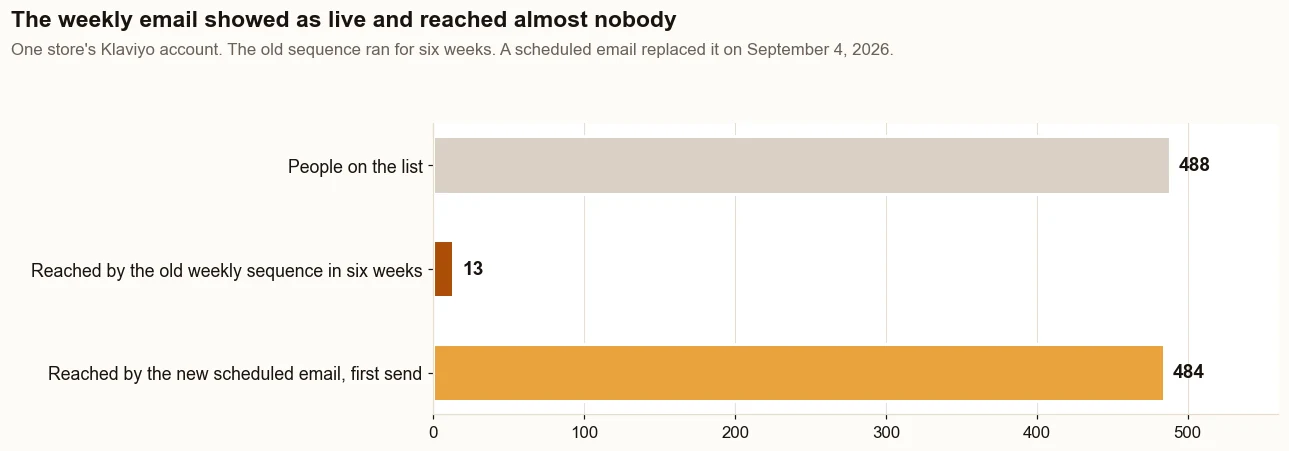
A series can look healthy and still miss almost everyone. On one direct to consumer store on Shopify, a weekly Klaviyo sequence built for 488 people showed as live for six weeks and reached 13 of them.
Its trigger only caught people added after it went live. A scheduled weekly email replaced it on September 4, 2026, and reached 484 people on its first send on September 8.
The five checks in the email audit guide are built to catch this. Klaviyo’s guide also asks whether a buyer who abandons a cart the next day will get your abandoned cart email on top of the thank-you, so check the overlap.
How do you measure post-purchase emails in Shopify?
Look for second purchases, not opens. Shopify’s customer reports include a Customer cohort analysis, which groups customers by the date of their first order. It can show the customer retention rate for each group.
The same page lists a Returning customers report for everyone with two or more orders. Compare the cohorts from before and after the emails went live, and report the change with the caveat below.
Klaviyo’s revenue figure is a different number. Its conversion tracking credits an order to any email opened or clicked within the attribution window, five days by default for newer accounts. It counts Apple Mail’s automatic opens too, unless you change that setting.
On one store, for August 17 to September 15, 2026, Klaviyo credited email with 23 orders. Shopify’s Total sales by referrer report traced 10 to an email click.
Both are defensible. Report both, and say which is which. The guide to Shopify analytics covers the other reports worth reading.
What do the numbers not prove?
A buyer who comes back might have come back anyway. To test that, Klaviyo’s A/B testing guide for branches lets you add a Random sample split. Part of your buyers skip an email, and you compare second purchases between the two groups.
What do repeat buyers look like in a real store's numbers?
They look smaller than the customer list suggests, and harder to email than expected. A second store, which sells at a counter and online on Shopify, shows the two numbers to read before any post purchase email is built.
In the 90 days to September 18, 2026, 145 identified customers placed an order there, and 34 of them bought more than once. In the 90 days before that, the figures were 45 and 15.
The caveat travels with the number: the store’s register was adopted during that window, so part of the rise is orders that Shopify had not recorded before, not only new buyers.
The second number decides whether a post-purchase flow can work at all. Of 541 orders in those 90 days, 113 carried a customer email address. At the register it was 34 of the last 242.
So most of that store’s buyers could not receive a post-purchase email, however good the flow. No post-purchase flow has been built there yet; capturing an email at the counter comes first.
The flows do exist on the store in the case study and on a third store, where the September 2026 audit found live flows with near-empty emails. Their repeat-purchase results are not in yet, so none are claimed here. The first-time buyers on the case study store, 25 over the 30 days before the work began (May 5 to June 3, 2026) and 53 in the 30 days about three months in (August 17 to September 15, 2026), are the pool those flows now have to work with.
What should you fix first?
Fix what decides who gets the emails before you polish the copy. A better subject line cannot fix a series that reaches a fraction of your buyers. This is the order used in The Traffic to Sales Method:
- Run the free Traffic to Sales Check. It reads Shopify, Google and email side by side to find where orders leak.
- Get names. Decide which consent status your post-purchase emails will honor, and make opting in easy at checkout.
- Get orders. Confirm the series reach close to every new buyer, then add the thank-you, first-use, review and follow-up emails.
- Show proof. Read the Customer cohort analysis in Shopify each month and report the returning share next to Klaviyo’s number.
This matters more as new customers grow. On the store in the case study, first-time buyers went from 25 in the 30 days before the work began, May 5 to June 3, 2026, to 53 in the 30 days about three months in, August 17 to September 15, 2026, by Shopify’s reports.
Each of them is someone a post-purchase email can reach. What that does not prove: it is one store, and Shopify counts a buyer as new on their first order, so it says nothing yet about how many came back.
If you would rather have this built inside your own Klaviyo and Shopify accounts, that is what Klaviyo email, done for you covers. For the rest of the automated series, see the Klaviyo flows every store needs, and for the busiest week of the year, the Black Friday email calendar.
What does a post purchase email program look like when it works?
A first-time buyer gets a thank-you within minutes, knows when the package will arrive, and has a short guide before it lands. A week after delivery they get one honest question about the product. Two weeks later they see the product that goes with it.
That experience is why your brand comes to mind first when they need more. Every month, Shopify’s cohort report shows how many of those buyers came back, and you can say which number came from Shopify and which from Klaviyo.
That is what a post purchase email program is for: a second order your store earned instead of paid for. Skip it, and every repeat purchase has to be bought again with ads. The case study shows the before and after on one store.
- Klaviyo Help Center: How to create a post-purchase flow
- Klaviyo: Klaviyo Releases 2023 Black Friday Cyber Monday Data (press release, November 29, 2023)
- Newcastle University TheoryHub: Cognitive dissonance theory
- Shopify Help Center: Setting up customer notifications
- Klaviyo Help Center: How to use flows to send transactional emails
- Shopify Help Center: Creating and managing marketing automations in Shopify Messaging
- FTC: CAN-SPAM Act, a compliance guide for business
- Klaviyo Help Center: Understanding consent in profiles
- Klaviyo Help Center: Shopify data reference
- Klaviyo: Post-purchase email guide
- Klaviyo Help Center: How to adjust review request timing
- Klaviyo Help Center: How to create a third-party product review flow
- FTC: The Consumer Reviews and Testimonials Rule, questions and answers
- FTC: Federal Trade Commission announces final rule banning fake reviews and testimonials
- Klaviyo Help Center: How to request reviews with Klaviyo Reviews flows
- Klaviyo Help Center: How to create an upsell or cross-sell flow
- Klaviyo Help Center: Understanding Smart Sending in Klaviyo
- Shopify Help Center: Customers reports
- Klaviyo Help Center: Understanding message conversion tracking
- Shopify Help Center: Sales reports
- Klaviyo Help Center: How to A/B test flow branches
- Klaviyo Help Center: Understanding flow analytics
- Klaviyo Help Center: How to create a replenishment flow
- Klaviyo Help Center: How to build dynamic blocks in a flow email
- Klaviyo Help Center: How to use event data to personalize email and SMS flows
- Klaviyo Help Center: Message personalization reference
Does this sound like your store?
If it does, the service that fixes it is Klaviyo email, done for you. You can see the before and after on one store in the case study.
Questions about this.
What is a post purchase email?
A post purchase email is any email a store sends after someone buys. It covers transactional messages, such as the order confirmation and shipping updates Shopify sends automatically, and marketing messages, such as a thank-you, first-use tips, a review request and a cross-sell, usually sent from Klaviyo or Shopify Messaging.
What should a post purchase flow include?
A thank-you on the day of purchase, first-use tips around delivery, a review request about a week after delivery and a cross-sell about two weeks after fulfillment. Split first-time buyers from returning customers, and leave order and shipping confirmations to Shopify's own customer notifications.
When should you send a post-purchase email?
Send the thank-you the same day, with no delay. Time the rest to delivery, not the checkout date. Klaviyo Reviews asks for reviews 7 days after delivery by default, and Klaviyo's built-in follow-up template waits 14 days from fulfillment before suggesting another product.
How many post-purchase emails should I send?
There is no fixed number. A good start is four marketing emails over the first few weeks, on top of Shopify's own notices: a thank-you, first-use tips, a review ask and a matching product. Check each email's unsubscribe rate in Klaviyo, which flags anything over 1 percent as Needs attention.
Can a post-purchase email show the product the customer bought?
Yes. In Klaviyo, a series triggered by a purchase can use a dynamic table that repeats for each item bought, with its name, image and quantity, and the pre-built Shopify templates already include it. These purchase details work only in triggered emails, not in campaigns, and a first name tag can greet the customer.
Can you offer a discount for a product review?
Yes, if the reward does not depend on the rating. The FTC's rule on consumer reviews bans incentives conditioned on positive or negative sentiment, and paying for 5-star reviews violates it. Offer the same reward to every reviewer, disclose it, and send it whatever the reviewer writes.
Are post-purchase emails transactional?
Only the ones whose main purpose is the purchase itself, such as a confirmation or a shipping update. The FTC reads those categories narrowly, so a thank-you with a discount, an email asking for reviews or a product suggestion is safest treated as marketing, with an unsubscribe link and your postal address.
What is post-purchase dissonance?
It is the doubt a buyer feels after a purchase. It comes from cognitive dissonance theory, which Leon Festinger first presented in 1957: thoughts that conflict with a choice create discomfort. A clear confirmation, delivery updates and first-use help give the buyer reasons to feel the purchase was right.
Why is my post-purchase flow not sending?
Compare the emails it sent with Shopify orders for the same dates. Causes to check are a series left in Draft or Manual, a consent filter that excludes buyers who never subscribed, a delivery trigger your carrier does not support, purchases never marked fulfilled, and Smart Sending skipping recent recipients.
How do you measure post-purchase emails?
Use Shopify's Customer cohort analysis report, which groups customers by first order date and shows how many come back, alongside Klaviyo's attributed revenue. Klaviyo credits orders within days of an open or click, including automatic Apple Mail opens, so report both numbers and say which is which.