AI SEO services for stores: get named when a buyer asks ChatGPT
When a buyer asks an AI engine what to buy or who to buy it from, the answer draws on pages it can reach and trust. The work is making your store one of them.
AI SEO for a Shopify store means making sure ChatGPT, Claude, Perplexity and Google's AI features can reach your pages, find the details buyers ask about, and trust the store enough to name it. Then it means measuring whether they do. Nobody can guarantee that an AI engine will name your store. The work is pages engines can reach, real product detail and honest measurement.
Is AI SEO a separate package?
No. You do not buy it on its own. AI search work is part of the Shopify SEO work, because ChatGPT, Perplexity and Google AI Overviews mostly draw on the same pages that rank in regular search. One job, one price, from $1,500 a month.
What is AI SEO for an online store?
AI SEO is the work of getting a store named and cited when someone asks an AI engine what to buy or who to buy from. People also call it AI search optimization, generative engine optimization or answer engine optimization. Google says there are no special requirements for its AI Overviews and AI Mode beyond being indexed and eligible to show in Search with a snippet, the short description under a result. Other engines work from the pages they can fetch, so reachability comes first everywhere.
How is AI search different from Google search for a store?
| Google search | AI answers | |
|---|---|---|
| What the buyer sees | Links, product listings and ads | A written answer that may name a few stores |
| What it works from | Google's index of pages | Pages the engine can fetch or has indexed, plus what other sites say about the store |
| How a store shows up | Rankings and free listings | Being named, and sometimes linked as a source |
| How it is measured | Search Console clicks, impressions and positions | A fixed list of buyer questions, with mentions and citations recorded |
What is the difference between SEO, AEO and GEO?
| Term | What people mean by it | What the work is on a store |
|---|---|---|
| SEO, search engine optimization | Ranking in search results such as Google’s | Indexable, specific product and collection pages |
| AEO, answer engine optimization | Being the source for a direct answer, such as an AI Overview | Clear answers with the facts buyers ask about, stated on the page |
| GEO, generative engine optimization | Being named or cited by ChatGPT, Perplexity, Gemini or Claude | Reachable pages, specifics in plain text, and measurement |
| LLMO, large language model optimization | The same goal as GEO, named after the models | The same work as GEO |
The labels are new. The job underneath is not. Google says the same foundational SEO practices apply to its AI features, which is why the work starts with pages search engines can reach and index.
Is SEO still worth doing now that AI answers questions?
Yes, because AI search runs on it. Google says there are no additional requirements to appear in its AI Overviews or AI Mode, and no special optimizations: the same foundational SEO practices apply. To be shown as a supporting link, a page has to be indexed and eligible to appear in Google Search with a snippet.
Other engines lean on search indexes too. OpenAI's help center says ChatGPT search sometimes partners with other search providers and sends them rewritten queries, and it points to Microsoft's privacy statement. Microsoft runs Bing. A store that is missing from those indexes is missing from the answers built on them.
Can ChatGPT do your SEO for you?
It can help with the writing. What it cannot do on its own is see the three reports that decide where the work should go: which pages Google has indexed, in Google Search Console; which products are approved for free listings, in Google Merchant Center; and which channel actually sold, in Shopify.
Google's guidance also draws a line. Using generative AI to produce many pages without adding value for people may break its spam policy on scaled content abuse. Google asks for accuracy, quality and relevance, however the content is made.
Which AI crawlers need to reach your store?
| Crawler | Company | What it does, per the company | robots.txt |
|---|---|---|---|
| OAI-SearchBot | OpenAI | Surfaces websites in ChatGPT search | Followed; blocked sites are not shown in ChatGPT search answers |
| GPTBot | OpenAI | Collects content for model training | Followed |
| ChatGPT-User | OpenAI | Visits pages for a ChatGPT user's action | May not apply |
| Claude-SearchBot | Anthropic | Improves Claude's search results | Followed |
| ClaudeBot | Anthropic | Collects web content for Anthropic's models | Followed |
| Claude-User | Anthropic | Fetches pages when a Claude user asks | Followed, per Anthropic |
| PerplexityBot | Perplexity | Surfaces and links sites in Perplexity search; not used for model training | Followed |
| Perplexity-User | Perplexity | Fetches pages for a user's question | Generally ignored |
| Google-Extended | A robots.txt control for some Google AI systems, separate from Search | Followed |
Blocking a training crawler such as GPTBot or ClaudeBot does not remove a store from AI search. Blocking the search crawlers does.
What does the work include?
- Access. Checks on robots.txt (the file that tells crawlers what they may visit), your CDN (the network that delivers your pages) and your bot settings, so search engines and AI tools can reach the pages that matter.
- Specifics in plain text. Product and collection pages that state what buyers ask about, instead of detail hidden in pickers or images.
- Accurate structured data. This is code that tells search engines what a page holds, such as product details or FAQs. It should describe the page as it is, with no special AI version sold as a shortcut.
- A consistent identity. The store's name, what it sells and where it ships stated the same way on the site and its profiles.
- Indexing. Your pages included in Google's and Bing's search indexes. Google's AI features require indexed pages, and AI search engines work from pages they can fetch.
- Measurement. A fixed list of buyer questions asked across ChatGPT, Claude, Gemini and Perplexity every month, with mentions and citations recorded separately.
How does an AI SEO engagement run, step by step?
- Access. You add a user login to Shopify, Google Search Console and Google Merchant Center, and keep ownership of every account.
- Reach. robots.txt, CDN and bot settings are checked, so search and AI crawlers can fetch the pages that matter.
- Index. The store is verified in Google Search Console and Bing Webmaster Tools, with the sitemap submitted to both.
- Baseline. A fixed list of buyer questions is run in ChatGPT, Perplexity, Gemini and Claude, and every mention and citation is recorded before anything changes.
- Pages. Product and collection pages are rewritten so the details buyers ask about are spelled out, and structured data is checked against what the page says.
- Free listings. Best sellers are published to Google's free listings, so Google has full product data to show.
- Measure. The same questions are run again each month, with mentions and citations reported separately.
What is done for you, and what stays with you?
| Done for you | Stays with you |
|---|---|
| Checking crawler access in robots.txt and bot settings | Ownership of the store, the domain and every account |
| Writing product and collection specifics into plain text | The product facts only you can confirm, such as materials, sizing and sourcing |
| Keeping structured data accurate | What customers say about the store in their reviews |
| Keeping the store's description consistent on the site and its profiles | Approving how the store describes itself |
| Running the monthly question list and reporting mentions and citations | Choosing which buyer questions matter most |
What is the difference between a mention and a citation?
A mention is when an AI answer names your store. A citation is when it links to your page as a source. An engine can do one without the other, so they are measured separately, and a report that blends them into one visibility score hides which one moved.
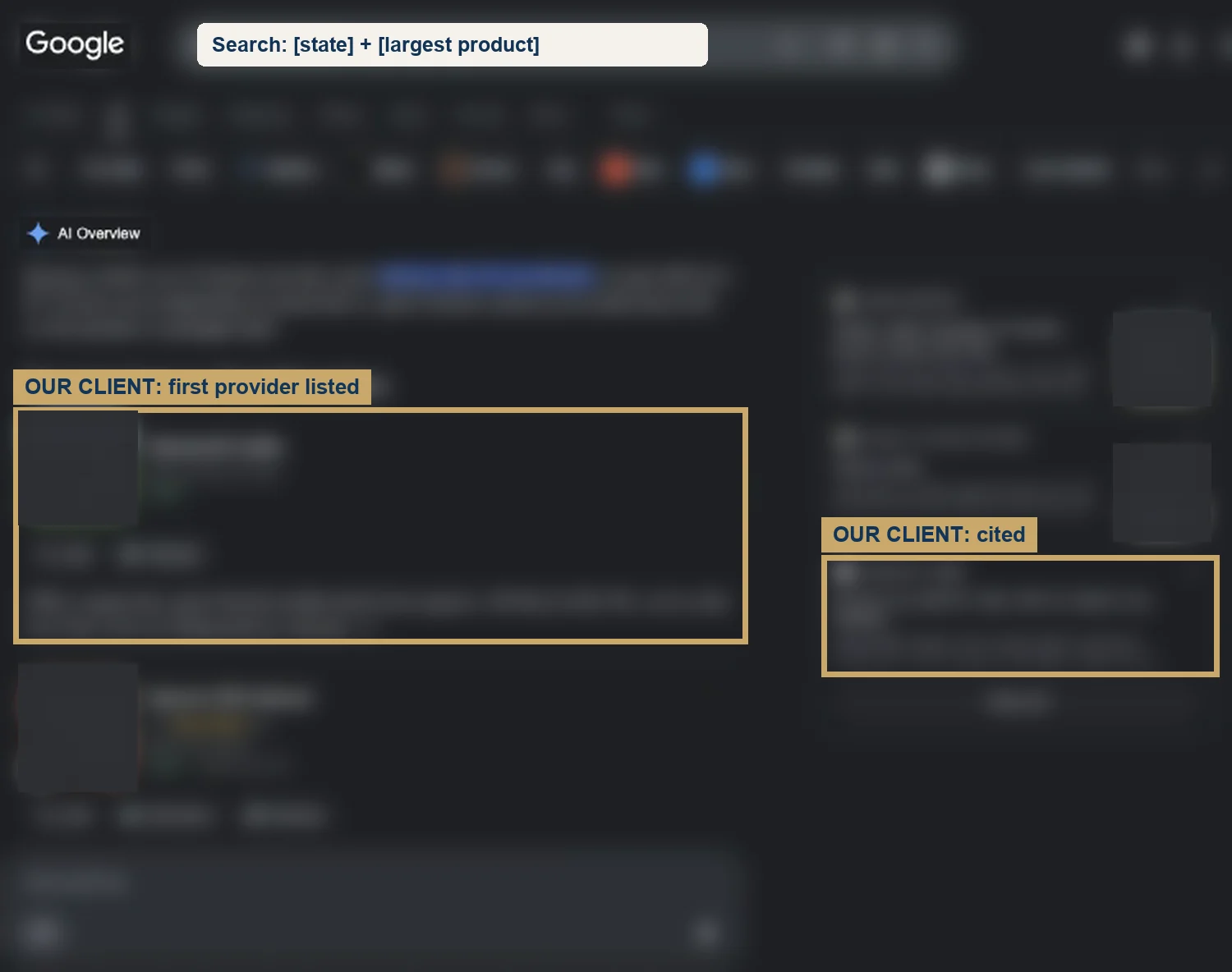
What does a citation in Google's AI Overview look like?
Here is one from a live Google search on September 3, 2026. For a statewide search for its largest product, the store in the case study was the first provider listed and one of the sources Google’s AI Overview cited.
How is AI visibility measured?
With a fixed list of the questions your buyers ask, run the same way every month:
| Record | Why it matters |
|---|---|
| Were you mentioned? | Shows whether the engine knows the store exists |
| Were you cited? | Shows whether it trusts a page enough to link it |
| Who was named instead? | Shows which competitors and sources it prefers |
| Which pages were cited? | Shows what kind of page earns citations for that question |
When this site ran that measurement on September 16, 2026, Shopify-owned sites were cited in 19 of 40 buyer answers and Google's help pages in 7. For store questions, AI engines lean heavily on official documentation, so a store's own pages need to be as specific and as well sourced as the pages they compete with.
What should a store tell AI engines about itself?
- Who you are. The store's name, what it sells and who it sells to, in one plain sentence near the top of the homepage and the About page.
- Where you sell. The countries or regions you ship to and how long delivery takes.
- What makes the products different. Materials, sizing, sourcing or guarantees, stated as facts a buyer can check.
- How to reach you. A contact page and consistent details on the profiles that describe the store.
Engines combine what the site says with what other sites say about it. When those disagree, they tend to repeat the most common version, which is why the same description needs to appear everywhere the store is listed.
What do buyers ask AI engines before they buy?
The questions that lead to a sale are specific. A useful list for a store mixes four kinds:
- Comparison: which is better for a given use, this product or that one?
- Fit: which size, material or version suits a need?
- Trust: is this store legitimate, and does it ship where I live?
- Local: who sells this near me, and who delivers to my city?
Each answer belongs on the product or collection page it is about, written in the same words buyers use.
Does an llms.txt file help?
An llms.txt file is a plain text summary of a site, written for AI engines. No major AI engine has committed to using one for ranking or citation. This site publishes one because it costs almost nothing to keep current, not because it wins citations. Be cautious of anyone who sells one as a strategy.
How long does AI SEO take to show up?
It starts with indexing, which takes as long as search engines take to crawl the pages, and no one controls that clock. After that, changes show up in the monthly measurement, question by question. Mentions and citations can move at different speeds, which is another reason to track them separately.
Why does a catalog need more than articles?
Most advice on this is written for software companies. A store's value is in specifics: size, material, weight, fit, shipping window. If that detail only lives inside the menu where a shopper picks a size or option, an engine has nothing to quote.
What will not move it?
No guaranteed citation, because nobody controls how an engine cites. No text file and no special markup sold as a shortcut. For brand citation work beyond a store's catalog, my business partner Joseph Timpson runs The Cited Method.
Who needs AI SEO, and who should wait?
- Worth doing now for a store whose buyers research before they buy, and for a store that is already indexed and ranking for some searches.
- Worth waiting on for a store that is not indexed yet, or whose product pages are a photo and a price. Those come first, and fixing them helps regular search as well.
How do you choose an AI SEO service?
Ask these questions before hiring anyone for this work:
- Do you check whether AI crawlers can reach the store before anything else?
- Do you measure against a fixed list of buyer questions, run the same way each month?
- Do you report mentions and citations separately?
- Do you work inside my accounts, and do I keep ownership of all of them?
- Do you promise a citation or a ranking? If the answer is yes, walk away. Nobody controls how an engine answers.
- Is an llms.txt file or special markup sold as the strategy? If so, keep looking.
- OpenAI: Overview of OpenAI crawlers
- Anthropic: Does Anthropic crawl data from the web, and how can site owners block the crawler?
- Perplexity: Perplexity crawlers
- Google Search Central: AI features and your website
- Google Search Central: SEO Starter Guide
- Google Search Central: Guidance on using generative AI content
- Google Search Central: Spam policies for Google web search
- OpenAI Help Center: ChatGPT search
Where does this fit in the method?
This is the Get Found stage of The Traffic to Sales Method. See it applied to one store, with the numbers, in the case study.
What does AI search work cost?
It is priced with Shopify SEO: from $1,500 a month, quoted by the size of your catalog.
What that is set against: the work is the same pages and product details that Google search reads, which is why the two are priced together. On one store, sales from Google reached $5,418 in the 30 days about three months in. AI search has no before and after on that store yet. See every price and its sources.
What changes when this works?
When a buyer asks ChatGPT, Perplexity or Gemini what to buy, your store is one the answer can reach, read and name. Or leave it to chance, and let the answer name someone else.
What does an AI mention look like?
When it works, a buyer asks ChatGPT, Perplexity or Google what to buy, and the answer names your store and links to it. AI search has no before and after numbers yet, so none are claimed here. What you see each month instead is one line per buyer question and engine: did the answer name your store, did it link to it, and who it named instead.
Questions about this.
What does an AI SEO agency do?
It gets your store named when a buyer asks ChatGPT, Perplexity or Google what to buy. Most of that is ranking well in regular search and getting named on outside pages AI already cites. Each month you see one line per buyer question and engine: did the answer name your store, did it link to it, and who it named instead. Here, I do that work myself.
Do you sell AI SEO as a separate package?
No. AI SEO is part of my Shopify SEO work and priced with it, from $1,500 a month. AI engines and Google read the same product and collection pages, so splitting the work in two would mean paying twice for one job. Prices are on the pricing page.
Do you offer AEO services?
Yes, as part of the Shopify SEO work, not as a separate service. AEO, answer engine optimization, is another name for getting your store named and linked when a buyer asks ChatGPT, Perplexity or Google a question. It works on the same product and collection pages as SEO, so you pay for one job, from $1,500 a month. See the pricing page.
What does AI SEO for a Shopify store include?
Checking that AI search crawlers can reach your pages, putting the details buyers ask about in plain text, keeping structured data accurate, getting pages indexed, and measuring mentions and citations across ChatGPT, Claude, Gemini and Perplexity every month.
Is SEO still worth it in 2026?
Yes. Google says the same foundational SEO practices apply to its AI features, and a page must be indexed to appear as a supporting link in AI Overviews. AI search is built on top of search, not instead of it.
Can ChatGPT do SEO for my store?
It can help draft copy and ideas. It cannot see your Search Console data, your Shopify sales or which pages are indexed, and it cannot make the changes inside your store.
Is AI making SEO obsolete?
No. AI engines answer from pages they can reach and trust, which is what SEO has always worked on. What changes is measurement: mentions and citations now need tracking alongside rankings.
Which AI SEO service is best for a Shopify store?
Look for one that checks crawler access first, works on your product and collection pages rather than only blog posts, measures mentions and citations separately, and refuses to guarantee a citation. Anyone who promises one is selling something nobody controls.
Does blocking AI crawlers protect my product content?
Partly. Blocking training crawlers such as GPTBot or ClaudeBot keeps content out of those companies' model training, according to their documentation, without removing the store from AI search. Blocking search crawlers such as OAI-SearchBot or PerplexityBot keeps the store out of those engines' answers.
Is there an AI tool that does SEO for a store?
There are AI tools that draft copy and suggest keywords. None can make an AI engine name your store, because that depends on what the engines can reach, what your pages say and what other sites say about you.
Other stages.
Shopify store audit
Shopify, Klaviyo and Google each say they are working. The audit checks them against what your store actually sold.
Shopify SEO, done for you
Most Shopify stores that do not rank are not losing on blog posts. They are losing on the product and collection...
Google Merchant Center and product feeds
Google's free product listings cost nothing, and your store can already use them. Most owners have never checked...
Klaviyo email, done for you
Email is the channel a store owns outright, and the one most likely to be quietly broken while every dashboard...
Guides on this.
ChatGPT SEO for Shopify stores: what gets a store named
ChatGPT shopping: how Shopify products show up in ChatGPT
How to connect Shopify to AI: Shopify MCP, ChatGPT and Claude
Generative engine optimization: what it means for stores
What is llms.txt, and does your Shopify store need one?
How to rank in AI Overviews with a Shopify store
Shopify Magic and Sidekick: what Shopify's AI tools do
Start with a conversation, not a contract.
Thirty minutes. If this is not your gap, I will tell you which one is.
Prefer email? herbert@herberttimpson.com