Home / Insights / ChatGPT SEO for Shopify stores: what gets a store named
AI search · 10 min read
ChatGPT SEO for Shopify stores: what gets a store named
Far more people ask AI engines about this than type it into Google. If you keep hearing that shoppers ask ChatGPT and have no idea whether your store ever shows up, here is what decides it, what a catalog needs that an article does not, and what is sold as a shortcut.
The short answer
Make sure ChatGPT's crawlers can reach your pages, put the details buyers ask about in plain text on those pages, and measure whether you are named for the questions your buyers ask. OpenAI says sites that block OAI-SearchBot are not shown in ChatGPT search answers. Nobody can guarantee a citation.
It can, once OpenAI’s crawler is let in, and there is nothing to submit. OpenAI’s help center says any public website can appear in ChatGPT search, and that a site becomes eligible when OAI-SearchBot can crawl it and the host accepts that crawler’s traffic.
Before anything else, confirm the AI crawlers can fetch the pages that matter. They have to be allowed in robots.txt, the file that tells crawlers what they may visit, and not blocked by your CDN, the network that delivers your pages. A store can be blocking them without knowing. OpenAI runs three:
Crawler
What OpenAI says it does
Follows robots.txt?
OAI-SearchBot
Surfaces websites in ChatGPT's search features
Yes. Sites that block it are not shown in ChatGPT search answers
GPTBot
Collects content used to train OpenAI's models
Yes
ChatGPT-User
Visits pages when a ChatGPT user's action calls for it
Not always, because a user started the visit
Blocking GPTBot keeps your content out of model training without removing you from ChatGPT search, which runs on OAI-SearchBot. Claude and Perplexity run their own crawlers, listed on the AI SEO page.
How do you check whether your store blocks AI crawlers?
Open your store's robots.txt file at yourstore.com/robots.txt and look for Disallow rules under GPTBot, OAI-SearchBot, ClaudeBot or PerplexityBot.
On Shopify, robots.txt is controlled by the robots.txt.liquid template. Shopify's help center says the default file works for most stores and warns that editing it is an unsupported customization.
Check your CDN or security settings too. A bot rule at the network level can block a crawler that robots.txt allows.
Open one product page, view its source and search for the price. If the price and description are not in the source, they load through scripts, and a crawler that does not run scripts will not see them.
Ask ChatGPT with web search to summarize one of your product pages. If it cannot, find out why before doing anything else.
Is ChatGPT SEO different from regular SEO?
Whether an AI engine cites you comes down to the same things that decide whether Google ranks you: pages it can reach, a reason to trust you, and something only you can say. What AI search adds is a measurement problem, not a new set of tricks.
Google's own guidance says the same about its AI features: there are no extra requirements or special optimizations for AI Overviews and AI Mode, and a page has to be indexed and eligible to show in Search with a snippet.
It goes by several names: generative engine optimization (GEO), answer engine optimization (AEO), LLM optimization and AI SEO. They describe the same goal, getting a store named and cited in AI answers, and the work underneath is the same. The AI search page compares the terms side by side.
No. ChatGPT search leans on search indexes: OpenAI's help center says it sometimes partners with other search providers and sends them rewritten queries. Google says the same foundational SEO practices apply to its own AI features, and that a page has to be indexed to be shown as a link in them. A store that search engines cannot find is hard for AI engines to find too.
ChatGPT is not limited to what it learned in training, either. OpenAI says it may search the web automatically when a question would benefit from current information, and answers that use search can cite their sources.
Can you use ChatGPT to do your SEO?
For drafts, yes: product descriptions, title ideas, answers to buyer questions. Check every fact before it goes live, because an AI draft can state a size, a material or a shipping time that is wrong for your product. Google's guidance asks for accuracy, quality and relevance, especially when content is generated automatically, and warns that using AI to produce many pages without adding value may break its spam policy on scaled content abuse.
For work that needs your own sales and product data, Shopify builds an assistant into the admin. According to Shopify, Sidekick has access to your store’s data and can act inside the admin; the guide to Shopify Magic and Sidekick covers what it can and cannot do.
How do Perplexity, Claude and Google's AI features differ from ChatGPT?
ChatGPT search relies on OpenAI's OAI-SearchBot. OpenAI says sites that block it are not shown in ChatGPT search answers.
Perplexity runs PerplexityBot, which it says surfaces and links websites in its search results.
Claude uses Claude-SearchBot to improve its search results, according to Anthropic.
Google's AI Overviews and AI Mode draw on Google Search. Google says a page must be indexed and eligible to show with a snippet to appear as a supporting link.
So a store can be visible in one engine and missing from another. Check each one separately.
It helps to be. OpenAI’s help center says ChatGPT search sometimes partners with other search providers, and it points to Microsoft’s privacy statement. Microsoft runs Bing. A store that only checks Google Search Console can miss that. Verify the store in Bing Webmaster Tools too, and submit the same sitemap, the file that lists your store's pages.
Why isn't your store showing up in ChatGPT when Shopify already sends your products?
Because being in the catalog is not the same as being recommended. OpenAI’s help center says product data from Shopify stores already reaches ChatGPT through Shopify Catalog, with no extra work from the merchant. Shopify turns this on by default for eligible stores.
What happens next is a ranking. OpenAI says a product appears when ChatGPT judges it relevant to the shopper’s request, and that not every available product is shown. When several stores sell the same item, it ranks them on availability, price, quality and whether each one is the maker or primary seller.
If Shopify says your products are connected and your store still never comes up, you are not imagining it. The catalog is the entry ticket. The details on your pages, your reviews and your prices decide the rest.
Shopify’s admin now shows part of that ranking. Under Sales channels, then Agentic, a search preview shows which of your products could rank in Shopify Catalog search for a query, with a listing quality score for each. Shopify calls it a directional signal, because AI channels often re-rank results their own way. The ChatGPT shopping guide walks through it.
What does a catalog need that an article does not?
Advice written for software companies assumes your value is explained in prose. A store's value is in a catalog: sizes, materials, weights, fit, shipping windows. If that detail only exists inside a variant picker, an engine has nothing to quote. Write down what a buyer asks before they spend: what it is made of, how it is sized, where it comes from and how fast it ships.
What should a product page spell out for AI answers?
What the product is made of, in plain words.
Sizes, dimensions or fit, written out rather than hidden in a picker.
Who it is for and who it is not for.
Care, use or setup details a buyer asks about before paying.
Shipping times and the return policy, stated on the page.
Product structured data, code on the page that tells machines your price and availability, helps them read those details. But there is no separate AI version of that code. The words on the page are what an engine can quote.
Why start with Google's free listings?
On one store the highest-value products had never been published through the store's Google channel, so free listings only showed thin versions Google found on its own. Sales from Google went from $354 in the 30 days before the work began to $5,418 in the 30 days about three months in, by Shopify's own reports. Before optimizing for answer engines, get the catalog onto the surfaces that are already free.
What is the difference between an AI mention and an AI citation?
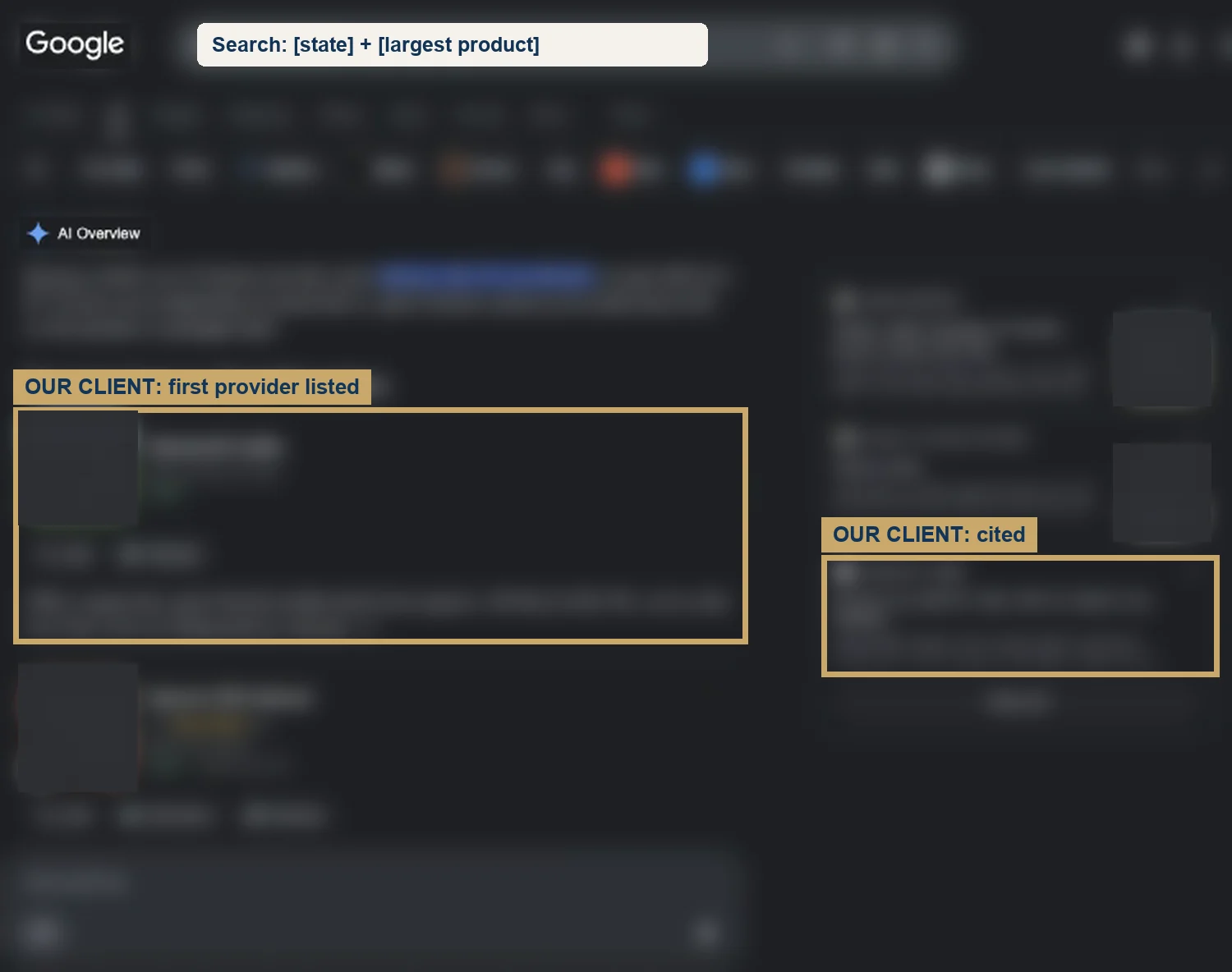
An AI mention is when an answer names your store or brand. An AI citation is when it links to your page as a source. They are different events: an engine can recommend a store without linking to it, or cite a page without recommending the store. Track them separately.A statewide search for the largest product of the store in the case study: the first provider listed, and cited in Google’s AI Overview. Names, places, photos and search words are blurred to protect the client. What it does not prove: AI Overviews change from search to search, and nobody controls which sources they cite.
How do you measure whether ChatGPT names your store?
Write down 10 to 20 questions your buyers actually ask, in their words.
Ask each one in ChatGPT, Perplexity, Gemini and Claude with web search on.
Record for each answer whether you were mentioned, whether you were cited, and who was named instead.
Run the same list every month and compare.
On September 16, 2026, this site asked those four engines 10 buyer questions about Shopify sales, ads, email and SEO. Of the 40 answers, 19 cited a Shopify-owned site such as the Help Center or Community, 7 cited Google's help pages and 5 cited Reddit. The rest of the citations spread across 120 other sites. herberttimpson.com, two days old and not yet indexed, was cited in none, which is the baseline this measurement exists to move.
What does a tracking sheet look like?
Column
What to write
Question
The buyer's question, word for word, kept the same every month
Engine and date
ChatGPT, Perplexity, Gemini or Claude, and the day you asked
Mentioned
Yes or no: did the answer name your store?
Cited
Yes or no, with the URL if the answer linked one of your pages
Named instead
Every store, brand or site the answer named or linked
What should you not pay for?
Do not pay for an llms.txt file, a text file that no major engine has committed to using for ranking. Every Shopify store already serves one by default, according to Shopify’s help center. Do not pay for a special block of structured data code, because there is no separate AI version of it. And do not pay for the idea that ranking first wins the answer, because AI answers pull from more sources than the top search results.
What is a ChatGPT SEO plan for a Shopify store, step by step?
Open yourstore.com/robots.txt and make sure OAI-SearchBot, the crawler behind ChatGPT search, is not blocked.
Check the bot and firewall settings at your CDN, which can block AI crawlers even when robots.txt allows them.
Verify the store in Bing Webmaster Tools and submit the sitemap.
Publish your best sellers to Google's free listings.
Write the details buyers ask about into each product page: size, material, weight, fit, care and shipping time.
Say who you are, what you sell and where you ship on the home page and the About page.
Write down the questions your buyers ask, run them in ChatGPT with search turned on, and record whether your store is named or linked.
Run the same questions each month, and change one thing at a time so you can see what worked.
The proof, from one store
Straight from the case study, with the source and what it does not prove. See all five results.
Result 3 · Google
Sales from Google: $354 to $5,418 in about 90 days
Before the work$354
→
About 90 days in$5,418
15x
Baseline: the 30 days before the work began
$354 from 2 orders that came in from Google, May 5 to June 3, 2026. The highest-value products in the catalog had never been published through the store's Google channel.
The work: what changed
Rewrote product names, titles, descriptions and search snippets around the terms buyers search, with real weights (August 7 to 30). Built six city landing pages (August 1 and 2). Published the store's highest-value products to the Google channel so they could show in free Shopping listings (August 24). Cleaned up crawl errors and expanded thin product pages to more than 400 words (August 27 to 30).
Result: about three months in
$5,418 from 17 orders that came in from Google, August 17 to September 15, 2026, 15 times the baseline.
Evidence source
Shopify Analytics, Total sales by referrer, Google row, pulled September 18, 2026.
What this does not prove
Shopify does not split Google search from free Shopping listings, so this cannot say which sold more. Four of the 17 orders were deposit orders, worth $2,070. Google Search Console only started collecting data on July 28, 2026, so there are no clicks from before the work to compare.
Test it on your store
In Shopify, open the Google and YouTube channel and check that your best sellers are published to it. In Search Console, open Performance, sort queries by impressions, and note the ones in positions 5 to 15. Then compare the Google row in Total sales by referrer for your most recent 30 days with the 30 days before your last change.
Want an AI SEO agency to do this for you?AI SEO services. I work remotely with Shopify stores across the US.
Straight answers
Questions about this.
How do I get my Shopify store recommended by ChatGPT?
Make sure AI crawlers like GPTBot and OAI-SearchBot can reach your pages, publish the specifics buyers ask about in plain text rather than only inside a variant picker, and track whether you are named for the questions your buyers ask. Nobody can guarantee a citation.
Is ChatGPT SEO different from regular SEO?
Underneath, it is still search: pages an engine can reach, real authority and detail only you can provide. What AI search adds is a measurement problem, because being mentioned and being recommended are different events.
Does an llms.txt file get a store cited by ChatGPT?
No major AI engine has committed to using llms.txt for ranking or citation. It costs little to publish one, but it is not a strategy.
Can you use ChatGPT for SEO?
For drafts and ideas, yes. It cannot see your Search Console data, your Shopify reports or which of your pages are indexed, so the decisions still have to come from those.
What is SEO for ChatGPT called?
It goes by several names: generative engine optimization (GEO), answer engine optimization (AEO) and AI search optimization. They describe the same goal: getting named and cited in AI answers.
Is SEO dead now that AI answers questions?
No. Google says the same foundational SEO practices apply to its AI features, and a page must be indexed to appear as a supporting link in AI Overviews. AI answers still draw on pages that search engines can reach and trust.
Which AI engine should a store check first?
The ones your buyers use. Run the same questions in ChatGPT, Perplexity, Gemini and Claude, because each engine uses its own crawler and sources, and a store named in one can be missing from another.
How can you tell if ChatGPT sends visitors to your store?
Check two places. Shopify's Agentic section, under Sales channels, reports sessions, orders and sales for each AI channel, including ChatGPT. OpenAI also tags referral links from ChatGPT search with utm_source=chatgpt.com, which analytics tools can count. A buyer who types your address later carries no tag, so ask new customers how they found you too.