Home / Insights / Generative engine optimization: what it means for stores
AI search · 14 min read
Generative engine optimization: what it means for stores
If someone has pitched you GEO, or told you SEO is dead now that shoppers ask ChatGPT, here is what the term means, what the search engines themselves say about it, and what it changes for a store that sells products.
The short answer
Generative engine optimization (GEO) is the work of getting your pages cited when AI engines like ChatGPT, Copilot and AI Overviews write a response. Google says optimizing for its AI search is still SEO. For a Shopify store, GEO means reachable pages, complete product data and honest measurement of citations.
Generative engine optimization is the work of making your content the source an AI response cites. A generative engine is an AI search tool that reads several sources, then writes one reply: ChatGPT with search, Microsoft Copilot, Perplexity or Google’s AI Overviews.
The term comes from a 2023 research paper, GEO: Generative Engine Optimization, later accepted to the KDD 2024 conference. It describes engines that use large language models to gather and summarize information for user queries. Its authors reported that their methods could boost visibility by up to 40% in the engines’ responses on their own test set.
They also found the effect varied by subject. Treat that figure as a lab result, not a promise for your store.
For a store owner the problem is plain. A buyer asks ChatGPT or Copilot what to buy and where, and the reply names other stores.
If you have felt that happening without being able to see it, you are not imagining it. Not every sale should have to come from paid ads, and these replies can send buyers for free.
Is generative engine optimization real, or just SEO?
Both, depending on who you ask. The engines disagree on the label more than on the work.
Krishna Madhavan, Meenaz Merchant, Fabrice Canel and Saral Nigam, Product Managers, Microsoft AI, Bing Webmaster Blog
Both are right. The work underneath is SEO: useful content that search engines can reach. What is new is the measurement, because a citation in an AI response is a separate event from where your page ranks.
What is the difference between GEO, answer engine optimization and AI search optimization?
Mostly the name. Google’s guide describes both AEO and GEO as terms for work focused on visibility in AI search experiences. AI search optimization is a third label for the same goal.
Term
Short form
What people usually mean
Search engine optimization
SEO
Ranking in search results
Answer engine optimization
AEO
Being the source for a direct reply, such as an AI Overview
Generative engine optimization
GEO
Being cited when an AI assistant writes a response from several sources
AI search optimization
None
A plain-English label for the same goal
The AI search service page compares what each label means for the work on a store. If a proposal treats them as four separate projects, ask what would actually be done differently.
Where do AI engines get what they say about your store?
From the pages they can fetch and the product data they are sent. Each company documents its own sources and runs its own report:
Engine
What it draws on, per the company
Where you can measure it
AI Overviews and AI Mode
Pages from the Search index, plus Merchant Center product data
Generative AI performance report in Search Console
ChatGPT
Pages its OAI-SearchBot can crawl, search partners, and Shopify Catalog for products
Visits tagged utm_source=chatgpt.com, and Shopify’s referrer reports
Microsoft Copilot
Web pages it cites, plus Shopify products through agentic storefronts
AI Performance report in Bing Webmaster Tools
OpenAI’s help center says ChatGPT search sometimes partners with other search providers, and it lists Microsoft’s and Shopify’s privacy policies (Searching the web with ChatGPT).
As of September 2026, Shopify says its agentic storefronts put products in ChatGPT, Google AI Mode and Gemini, Microsoft Copilot and Meta. They are on by default for eligible stores (Shopify agentic storefronts).
How do AI engines choose which sources to cite?
They search first, then write. Google’s guide describes retrieval-augmented generation: its core ranking systems fetch relevant pages from the Search index, and the AI responses link to the pages that support them. It also uses query fan-out, a set of related queries the model generates to address the user’s query.
OpenAI’s help center says ChatGPT search typically rewrites a question into one or more targeted queries for its search partners. Bing calls the pages behind a reply its grounding: the source material and web evidence the system uses to support and cite its response (Bing’s June 2026 update).
So the first filter is ordinary search. Content that search engines cannot find, or cannot rank for related queries, rarely makes it into the reply.
What content do AI engines cite?
Content that is specific, clear and easy to check. Google’s guide says the content most likely to do well offers a unique point of view and detail beyond common knowledge. It calls this non-commodity content.
Bing’s team gives the most practical list of any engine. It says clear headings, tables and FAQ sections help surface key information and make content easier for AI systems to reference accurately. It adds that examples, data and cited sources build trust when content is reused in AI-generated answers, and that fresh, accurate content matters too.
You also do not need to chase every keyword variation. Google says its AI systems understand synonyms and general meaning, so write for the buyer in plain words.
Do mentions on other sites matter for generative engine optimization?
Real ones can; bought or planted ones do not help. Google’s guide says its AI features can show what is being said about products across the web, including blogs, videos and forum discussions. It adds that seeking inauthentic mentions is not as helpful as it might seem, because other systems block spam.
OpenAI describes the same mix for shopping answers. Its help center says ChatGPT considers structured product data from first-party and third-party providers, plus other third-party content. ChatGPT’s review summaries are based on reviews from public websites (Shopping with ChatGPT Search).
If your store is new and has few reviews, that can feel like a club for big brands. The way in is slow and honest:
Ask real buyers for reviews, on your product pages and wherever your buyers already read them.
Give writers facts they can check. Sizes, materials and test results make a product easy to include in a roundup or comparison.
Find the pages that get cited. The monthly check of buyer questions described below shows which sites the engines cite. Those are the pages worth being on.
Never buy reviews. The FTC’s final rule on fake reviews, announced in August 2024, prohibits buying fake reviews and offering rewards on condition that a review is positive or negative (the FTC’s announcement).
Is GEO replacing SEO?
No, because GEO runs on it. Every system above retrieves pages through search before it writes. OpenAI’s help center says a site becomes eligible for ChatGPT search by letting OAI-SearchBot crawl it and letting its host accept that crawler’s traffic.
Shopify gives store owners the same advice. Its help center says that for product data accuracy and discoverability with AI agents, you should focus on complete, well-structured product information in Shopify Catalog and on following SEO best practices (Shopify Catalog and product discovery). The ecommerce SEO guide covers that foundation.
Is SEO still worth it now that AI answers questions?
Yes. As of September 2026, Google says AI Overviews have over 2.5 billion monthly active users, and those responses are built from pages its ranking systems retrieve (its update for website owners). It also argues that clicks have held up:
“total organic click volume from Google Search to websites has been relatively stable year-over-year”
That is a search engine grading its own homework, so check your own store. Here is what Shopify’s sales attribution report showed for one direct to consumer store:
Google search, not paid24 ordersfrom 1,720 visits: 1.4 percent bought
Google search brought in more than 3.5 times the sales of the paid ads, from under a fifth of the traffic.
Source: Shopify’s sales attribution report for the 90 days before September 3, 2026. Google search brought $8,316 in sales and paid Facebook and Instagram $2,322, as charged. What it does not prove: the report credits each order to the visit it came from, so an ad that first introduced a buyer who later searched Google gets no credit.
It is one store and one report, and it says nothing about AI replies directly. It does show that search traffic can still outsell paid social, and search is what these replies are built on.
What does GEO mean for a Shopify store?
It means your catalog is the content. Much GEO advice is written for publishers whose content is articles. A store sells products, and the data about them now travels to AI engines on its own.
Shopify says its Catalog uses signals from millions of merchants and products to structure product data so AI can understand it (Shopify’s agentic storefronts announcement). That only works as well as your data. A product with a vague title, one photo and no sizes gives every engine less to match.
Titles and descriptions that say what the product is, who it is for and what it is made of.
Specifics in plain text: sizes, weights, fit, care and delivery times.
Policies for shipping and returns, stated on the site.
The same facts in every digital channel: your site, Merchant Center and marketplaces.
Which generative engine optimization strategies work for an online store?
The ones that make your store easy to fetch, easy to read and easy to trust. In order:
Let the engines in. Check that robots.txt and your host allow the search crawlers, such as OAI-SearchBot. The ChatGPT SEO guide lists the crawlers and how to check them. OpenAI says a robots.txt change takes about 24 hours to reach ChatGPT search (Overview of OpenAI crawlers).
Get indexed. Verify the store in Search Console and Bing Webmaster Tools, and submit your Shopify sitemap to both.
Send the catalog. Publish products through Shopify’s Google & YouTube channel to Merchant Center, and leave agentic storefronts on for the AI channels you want.
Write the specifics. Put sizes, materials, care and delivery details in plain text, with clear headings, tables and FAQ sections.
Measure citations and sales. Read the first-party reports each month, and judge the result in Shopify’s own reports.
“Focus on your visitors and provide them with unique, satisfying content.”
That advice sits under every step. The steps follow The Traffic to Sales Method: find the gaps, Get Found, then Show Proof from Shopify’s own numbers.
What GEO tactics should you skip?
Google’s guide lists what you can ignore for its AI features: llms.txt and other AI text files, chunking pages into small pieces, rewriting content in a special style for AI, inauthentic mentions and special schema markup. The AI Overviews guide sets out that list with what to do instead.
The engines add two more warnings. Google’s guidance on third-party SEO services asks site owners to think critically about tools that promise improvements for AI experiences, which it says are also known as AEO or GEO tools. It adds that third-party tools do not have access to its internal ranking data (its guidance on third-party advice).
OpenAI’s help center says placement in ChatGPT search is not guaranteed.
So skip anyone who guarantees citations, sells a visibility score from their own software as proof, or offers to plant mentions of your store around the web. The llms.txt guide covers what that file really does.
Which GEO tools are worth using?
Start with the reports the engines run themselves. They are the only ones with first-party data.
Report
Who runs it
What it shows
Generative AI performance report
Search Console
Impressions in AI Overviews and AI Mode, by page, country, device and date
AI Performance report
Microsoft, in Bing Webmaster Tools
Citations in Copilot and Bing’s AI-generated answers, cited pages and grounding queries
utm_source=chatgpt.com
OpenAI adds it to referral links
Visits from ChatGPT search in your analytics
Sales reports by channel and referrer
Shopify
Which visits and AI channels turned into orders
The Search Console report has been available to all websites since August 31, 2026 (Search Console Help). OpenAI says it adds the utm_source=chatgpt.com tag automatically (Publishers and Developers FAQ).
Add one manual check: a fixed list of buyer questions, asked in each engine every month, with mentions and citations recorded separately.
What did AI engines say about this site eight days after launch?
Here is that manual check, run on this site. It went live on September 16, 2026, and on September 24, eight days later, I asked five assistants who I am and what this domain is.
A ChatGPT-type model with search described the site accurately and cited the /expertise/ page, with utm_source=openai on the link. Grok described the domain accurately and cited it.
Perplexity, Gemini and Google’s AI Mode did not have the site at all. AI Mode said the domain was “not an active or official website.”
Access was not the reason. The site’s robots.txt names every AI crawler as allowed, GPTBot, OAI-SearchBot and PerplexityBot among them, and on September 24 eleven AI crawler user agents all fetched a guide with a 200 response. Search Console showed 22 of 25 pages indexed, so what the site lacked was age and citations.
The split is the lesson. The two assistants that found the site were searching the live web as I asked; the ones that lean on their own index had nothing on a domain eight days old. No file or markup changes that, only time and the genuine mentions described above.
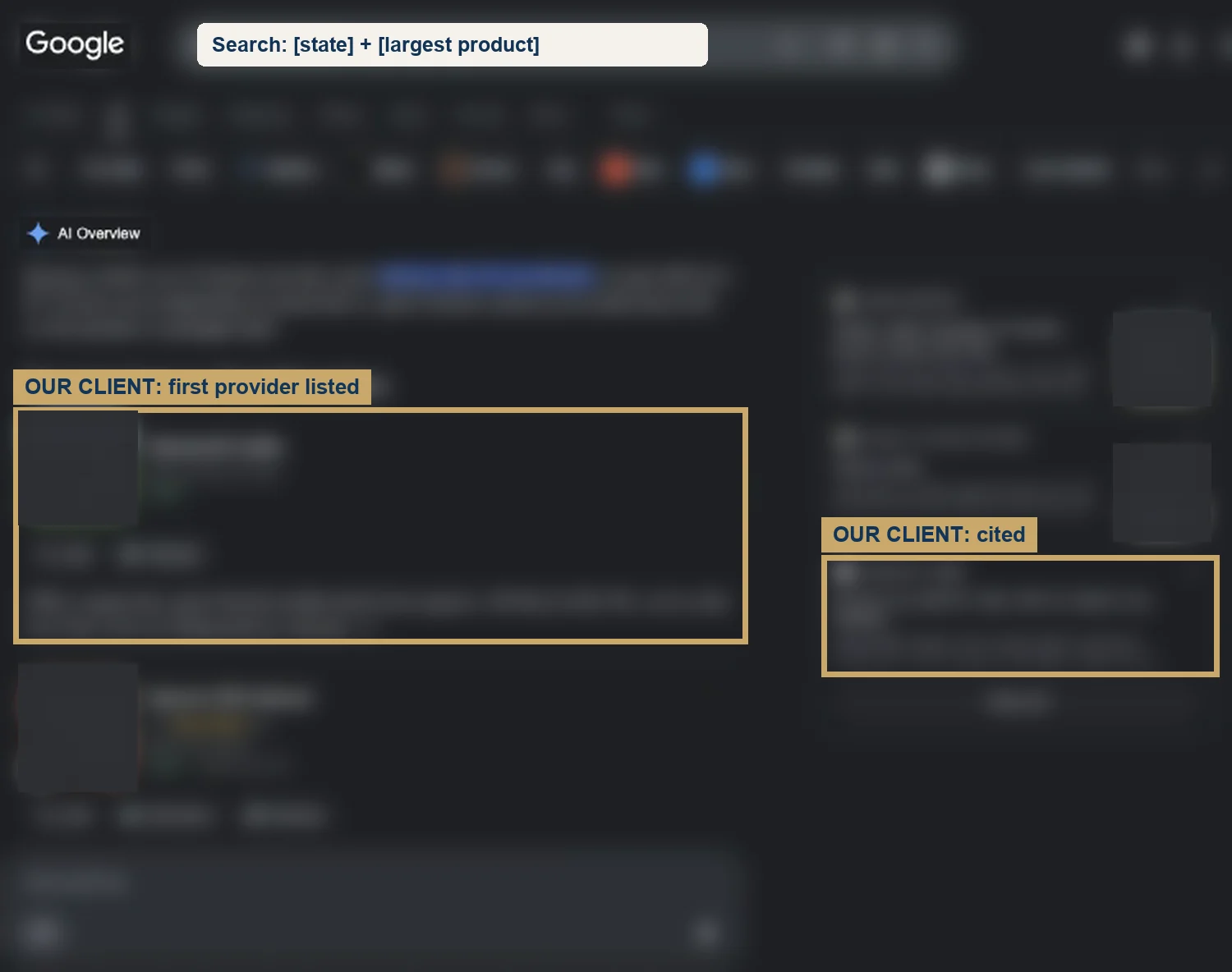
The store in the case study shows the other end of that road. Its best sellers were published through Shopify’s Google channel on August 24, 2026. In September 2026, for a statewide search for its largest product, it was the first provider listed and one of the pages Google’s AI Overview cited.
A statewide search for the store’s largest product: the first provider listed, and cited in Google’s AI Overview. Names, places, photos and search words are blurred to protect the client. What it does not prove: AI Overviews change from search to search, and nobody controls which sources they cite.
Can ChatGPT do SEO for your store?
It can draft. It cannot see your Search Console data, your Merchant Center feed or which channel sold in Shopify, so the decisions still come from those reports. The ChatGPT SEO guide covers what ChatGPT can and cannot do for a store, so it is not repeated here.
What does generative engine optimization look like when it works?
A buyer asks an AI assistant which product fits their need, and the response cites your product page because it is the clearest source. Search Console shows the impressions, Bing shows the citations, a utm_source tag shows the visits, and Shopify shows the orders.
That is generative engine optimization done honestly: the same information, read from the reports each company runs.
If you want to see where your store stands first, the free Traffic to Sales Check reads Shopify, Google and your email side by side. Leave it, and the replies still get written, with other stores in them.
The proof, from one store
Straight from the case study, with the source and what it does not prove. See all five results.
Result 3 · Google
Sales from Google: $354 to $5,418 in about 90 days
Before the work$354
→
About 90 days in$5,418
15x
Baseline: the 30 days before the work began
$354 from 2 orders that came in from Google, May 5 to June 3, 2026. The highest-value products in the catalog had never been published through the store's Google channel.
The work: what changed
Rewrote product names, titles, descriptions and search snippets around the terms buyers search, with real weights (August 7 to 30). Built six city landing pages (August 1 and 2). Published the store's highest-value products to the Google channel so they could show in free Shopping listings (August 24). Cleaned up crawl errors and expanded thin product pages to more than 400 words (August 27 to 30).
Result: about three months in
$5,418 from 17 orders that came in from Google, August 17 to September 15, 2026, 15 times the baseline.
Evidence source
Shopify Analytics, Total sales by referrer, Google row, pulled September 18, 2026.
What this does not prove
Shopify does not split Google search from free Shopping listings, so this cannot say which sold more. Four of the 17 orders were deposit orders, worth $2,070. Google Search Console only started collecting data on July 28, 2026, so there are no clicks from before the work to compare.
Test it on your store
In Shopify, open the Google and YouTube channel and check that your best sellers are published to it. In Search Console, open Performance, sort queries by impressions, and note the ones in positions 5 to 15. Then compare the Google row in Total sales by referrer for your most recent 30 days with the 30 days before your last change.
Want an AI SEO agency to do this for you?AI SEO services. I work remotely with Shopify stores across the US.
Straight answers
Questions about this.
What does GEO stand for?
GEO stands for generative engine optimization: the work of getting your content cited when AI engines such as ChatGPT, Microsoft Copilot or AI Overviews write a response. The term comes from a 2023 research paper. Google says that, from its point of view, this work is still SEO.
Is GEO different from SEO?
The work is mostly the same, because AI engines search before they write a response. What differs is measurement: you track citations of your content in AI replies as well as rankings. Search Console and Bing now both report on how a site appears in AI features.
What is answer engine optimization?
Answer engine optimization, or AEO, is the work of making your page the source for a direct reply, such as an AI Overview. Google's guide describes AEO and GEO as terms for work focused on visibility in AI search experiences, and treats both as part of SEO.
How do you measure generative engine optimization?
Use the engines' own reports: the generative AI performance report in Search Console, the AI Performance report in Bing Webmaster Tools, and visits tagged utm_source=chatgpt.com. Then judge the result by orders in Shopify's reports, not by a visibility score from third-party software.
Do you need special files or markup for GEO?
Not for Google. Its guide says Search ignores llms.txt and other AI text files, and that no special schema.org markup is needed for its AI features. Structured data that matches the page still helps with rich results. None of it replaces clear, specific content.
How long does GEO take to work?
There is no fixed timeline. OpenAI says a robots.txt change can take about 24 hours to reach ChatGPT search results, and Google says crawling can take from several days to several months. After that, results depend on the query, so measure month by month rather than day by day.
Why does a store rank on Google but not show up in AI answers?
Because each engine runs its own searches. Google says AI Overviews may run several related searches across subtopics, and OpenAI says ChatGPT rewrites a question into targeted queries for its search partners. A page that ranks for one phrase may not answer those sub-questions. ChatGPT also needs OAI-SearchBot allowed to crawl the store.
Can a GEO tool show what ChatGPT says about your store?
Only for the prompts it runs. OpenAI says ChatGPT can use a person's saved memories and approximate location when it rewrites a search, and that products are tailored to each shopper's preferences and context. Two buyers can get different answers. Treat a tool's score as a sample, and trust the engines' own reports first.
Can a GEO agency guarantee AI citations?
No. OpenAI's help center says placement in ChatGPT search is not guaranteed, and Google says outside SEO software has no access to its internal ranking data. Anyone who guarantees a citation is selling something nobody controls. Ask how they will measure your content's citations instead.