Home / Insights / Klaviyo vs Mailchimp: which is better for a Shopify store?
Email · 17 min read
Klaviyo vs Mailchimp: which is better for a Shopify store?
Still on Mailchimp and wondering whether Klaviyo is worth the switch, or whether its cost climbs too fast? Here is the comparison on the points that decide a Shopify store's email sales, with each vendor's own prices as of September 2026 and a way to check the result in your store's own reports.
The short answer
Klaviyo vs Mailchimp comes down to how you sell. For a Shopify store whose email should react to browsing and orders, Klaviyo fits better. Mailchimp costs less for large, newsletter-style lists: as of September 2026, 25,000 contacts cost $310 a month on Mailchimp Standard against $400 on Klaviyo.
Klaviyo vs Mailchimp: which is better for a Shopify store?
For a Shopify store that wants email marketing to sell, Klaviyo is usually the stronger fit. It is designed around store behavior: products viewed, carts started, purchases made.
Mailchimp gives more for the money on a large list that mostly reads a newsletter. It also suits a business that already runs its books in QuickBooks, since both belong to Intuit.
If Mailchimp felt simpler and Klaviyo looks more powerful but more complex, that reading is fair: Klaviyo does more with store data, so it asks more of you. And if you have gone back and forth on this, that makes sense too: each vendor publishes a page arguing that it wins.
Neither tool fixes a program that does not send. The comparison below covers price, automation, segmentation, reporting, AI, SMS and support. It also covers the part most reviews skip: how each one counts the sales it takes credit for.
They share more than their marketing suggests. Both have a free tier for 250 people, both connect to Shopify, and both sell SMS on top of email. The differences are in what they count, what they automate and who they were built for.
Klaviyo
Mailchimp
Company
Founded 2012, based in Boston, public as KVYO
Founded 2001 in Atlanta, owned by Intuit since 2021
Shopify App Store rating, September 2026
4.7 from 3,313 reviews
4.8 from 1,468 reviews
Free tier
250 active profiles, 500 emails a month, flows included
250 contacts, 500 sends a month (250 a day), no automation flows
Cheapest paid tier
$20 a month for 500 active profiles
$13 a month for 500 contacts (Essentials)
What you are billed on
Active profiles; unsubscribed and suppressed people stop counting
Contacts, including unsubscribed and non-subscribed, unless archived
Monthly send allowance
10 times your profiles
10, 12 or 15 times your contacts, by tier
Automation
Flows on every tier, including free
Up to 4 flow steps on Essentials; up to 200 flows on Standard and Premium
SMS
Monthly dollar spend; $5 a month included
Credit add-on from Essentials up, after an approved application
Integrations
350+, per its homepage
300+, per its pricing page
Emails in several languages
Smart Translations, paid accounts only, 60+ languages
Merge tags that show versions you translate, or Google Translate links
Below 5,000 people, the two are close, and Klaviyo is cheaper than Mailchimp Standard at some sizes, such as 1,000. From 10,000 up, Mailchimp Standard costs less at every size checked, and Essentials, with fewer features, is the cheapest throughout. These are list prices as of September 2026, according to Klaviyo’s pricing page and Mailchimp’s pricing page.
List size
Klaviyo
Mailchimp Essentials
Mailchimp Standard
Mailchimp Premium
500
$20
$13
$20
$350
1,000
$30
$26.50
$45
$350
2,500
$60
$45
$60
$350
5,000
$100
$75
$100
$350
10,000
$150
$110
$135
$350
15,000
$350
$180
$230
$465
25,000
$400
$270
$310
$620
50,000
$720
$385
$450
$815
100,000
$1,380
Not offered
$800
$1,025
Monthly list prices in US dollars. Mailchimp also advertised 15 percent off the first 12 months for lists of 10,000 or more, and Essentials stops at 50,000 contacts.
Why the same list can cost more on either one
The two count different people. Klaviyo bills active profiles: anyone it can reach, including shoppers who typed an address at checkout without subscribing.
Mailchimp counts subscribed, unsubscribed and non-subscribed contacts unless you archive them. Connecting Shopify also adds your customers to your Mailchimp audience as contacts.
Mailchimp also bills on the total across all your audiences, so a person listed in two audiences adds to that total twice. Its audience guide says one audience could save you money if you have duplicates.
So an old list full of unsubscribes costs more on Mailchimp until you archive it. A store with heavy checkout traffic adds billable people on Klaviyo every day. The full tier table is in Klaviyo pricing: what you will actually pay.
“the fundamental unit of a business is the customer.”
That belief is why Klaviyo prices on profiles with sends included. It also means you pay for every reachable person, so list hygiene is a cost control on either platform as you scale.
When checked on September 18, 2026, Mailchimp’s pricing page was also showing a first-year offer: 15 percent off these monthly prices for 12 months.
Which is better for automation?
Klaviyo, for a store. Its flows can start from any store event it receives, and they run on every tier, including the free one. Mailchimp’s automation flows are paid-only and limited to four steps on Essentials.
Klaviyo’s help center says any data syncing to your account can trigger and target a flow. It pre-fills best practice flows and suggests setting four live first: welcome, abandoned cart, post-purchase and winback. The ones worth running first are in Klaviyo flows every Shopify store needs.
Mailchimp renamed its Customer Journey Builder to Marketing Automation Flows in June 2025, and its pricing page lists up to 200 flows on Standard and Premium. Its Shopify integration page names welcome emails, abandoned cart reminders and back-in-stock alerts among the triggers. Mailchimp’s comparison page claims more than 45 behavioral triggers.
The automation features on both are enough for the core flows. The gap shows up in how finely a flow can react to what one shopper did in your store.
Which has better segmentation?
Klaviyo has the edge for store data, while Mailchimp’s best segmentation sits on its Standard tier and up. Segmentation is how you pick who gets a message, and it decides whether campaigns feel personal or random.
Klaviyo: groups built from browsing, purchases and engagement on every tier. Its comparison page says they update in real time from data across 350+ integrations.
Mailchimp: Standard adds advanced segmentation and pre-built segments, and predictive segments come with Standard or Premium only, according to its pricing page. Its Shopify integration syncs customer segments from Shopify and uses Shopify pixel events.
Groups only help if they reach real readers. Build them on clicks and purchases rather than opens, because Apple Mail records opens nobody made.
How does each one connect to Shopify?
Both install from the Shopify App Store and pull in customers and purchases. Klaviyo adds onsite tracking through its app embed. Mailchimp uses Shopify pixel events and can show campaign revenue inside your Shopify dashboard.
Klaviyo’s app launched on the store in 2012. Mailchimp’s current app, from developer Intuit Mailchimp, launched on November 28, 2018.
Shopify also has a stake in the outcome. It made a strategic investment in Klaviyo in 2022, and Klaviyo became the recommended email solution partner for Shopify Plus, per the partnership announcement.
“Klaviyo has become invaluable to hundreds of thousands of merchants”
Read that as a partner and investor speaking, not a neutral judge. The fair test is the same for both tools: what your own reports show after the switch.
How does each tool count the sales it takes credit for?
Differently, and neither matches Shopify. Each credits a sale to the last message a person interacted with inside its own attribution window. Their revenue numbers are not comparable with each other or with your store’s reports.
Every tool grades its own homework. On one direct to consumer store on Shopify, for August 17 to September 15, 2026, Klaviyo credited email with 23 orders. Shopify’s Total sales by referrer report traced 10 to an email click.
Both counts are defensible; they measure different things. Whichever tool you choose, judge it in Shopify, on the same dates, before and after.
Which has better reporting?
Both show opens, clicks and attributed revenue out of the box; the deeper reports cost extra on both. What neither report can do is replace your store’s own numbers.
Klaviyo: its pricing page lists built-in reporting and dashboards, campaign performance metrics and revenue attribution for campaigns, even on the free tier. Deeper customer analysis sits in the paid Personalization add-on, formerly Marketing Analytics.
Mailchimp: custom reports come with Standard and Premium, per its pricing page. Its attribution guide notes that ecommerce revenue reports show net revenue, without shipping fees or taxes.
That detail alone means the amount Mailchimp shows for a sale can differ from what other reports show for the same purchase. For decisions, use Shopify’s sales reports as the scorecard and each vendor’s reports as a diagnostic.
How do their AI features compare?
Klaviyo prices its AI agents by usage; Mailchimp includes its AI assistant on higher tiers at no extra cost. Neither changes who is on your list.
Klaviyo offers features like Composer, an AI marketing agent that drafts on-brand campaigns, listed at $20 a month on its pricing page. Customer Agent, its AI customer service assistant, is priced by resolved conversations. At K:BOS 2026, it also opened its tools to Claude and ChatGPT through Klaviyo Headless.
Mailchimp lists generative AI features as a no-cost add-on on Standard and Premium. Its pricing page says Intuit Assist, in beta, is available at no additional cost to certain Premium, Standard and Legacy users in select countries.
AI can draft a campaign in seconds. It still reaches only the people your forms and checkout have identified, so capture comes first on either platform.
Which is better for email SMS marketing?
Klaviyo, if texts matter to your store, because it bills them as a simple monthly spend and covers more channels. Mailchimp’s texting works too, but it takes an application and a credit subscription first.
Klaviyo: you set a monthly dollar spend, each message uses a rate by channel and country, and carrier fees are included. Every account gets $5 of mobile messages free each month, and rates cover SMS, MMS, WhatsApp and RCS, per Klaviyo’s mobile messaging guide.
Mailchimp: texting is an add-on from Essentials up, and you must submit an application and be approved before sending. Credits renew monthly, unused ones are forfeited, and MMS needs Standard or Premium for US and Canada, per Mailchimp’s SMS guide.
On both, texts need their own consent, separate from email. Build that list on purpose rather than assuming subscribers agreed to texts.
Which is easier to use?
Both are easy to start, and both get harder when you ask them to react to store behavior. Mailchimp grew up doing email marketing for small businesses of every kind; Klaviyo grew up serving ecommerce brands.
“Mailchimp has been on a tremendous journey empowering small businesses to grow”
That history shows. Mailchimp offers a broad set of marketing tools for any small business, while Klaviyo leans into ecommerce: ready-made store flows, product blocks and store-event triggers.
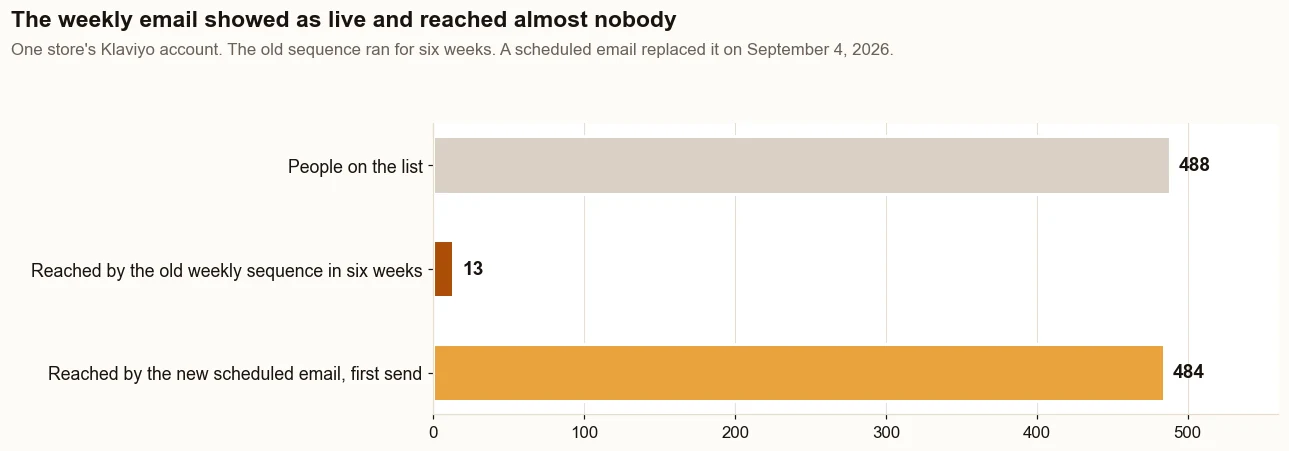
Ease of setup matters less than ease of checking. On one store, a weekly sequence built for 488 people showed as live for six weeks and reached 13 of them. Its Added to List trigger only caught people added after the flow went live.
A scheduled weekly campaign replaced it on September 4, 2026 and reached 484 people on its first send. The same trap exists on any platform, which is why five checks for whether your email is really working come before any switch.
The weekly sequence reached 13 people in six weeks while it showed as live. The scheduled email that replaced it reached 484 on its first send. Source: the store’s Klaviyo account.
What does a hands-on Klaviyo audit show that a comparison cannot?
It shows what an account actually sends, which no feature table can. One honest note first: the Mailchimp half of this comparison is documentation, from Mailchimp’s own pricing and help pages, because no Mailchimp account has been run for a client in the work behind these guides. The Klaviyo half comes from accounts opened and checked by hand.
The weekly sequence above is one example: 13 people reached in six weeks, then 484 on the first scheduled send. A second store, on Shopify with Klaviyo, showed a different kind of gap in its September 2026 audit.
Seven live flow emails were close to empty. They showed as live with almost nothing in them.
Seven more carried internal notes that were never meant for customers.
The unsubscribe link was broken in every flow and in the quarterly campaigns already sitting in the queue.
All of it was found and fixed on September 14, 2026, inside the store’s own Klaviyo account. None of it would show up in a pricing table, and an unsubscribe link that does not work is a fault on any platform.
What it does not prove: two stores’ accounts say nothing about Mailchimp’s editor or Klaviyo’s average customer. They do show that the checks matter more than the logo. Whichever tool you pick, open every live flow and read it as a customer would.
Which has better support?
Mailchimp offers more support on paid tiers, including phone on Premium. Klaviyo gives paid users email and chat, and limits free users to email support for the first 60 days.
Tier
Klaviyo
Mailchimp
Free
Email support for the first 60 days
Email support for the first 30 days
Entry paid
Email and chat
24/7 email and chat (Essentials)
Mid
Email and chat
24/7 email and chat, plus one onboarding session (Standard)
Top
Email and chat; enterprise support packages sold separately
Phone and priority support (Premium)
Sources: Klaviyo’s guide to free and paid plans and Mailchimp’s pricing page, September 2026. Klaviyo notes that chat availability varies by location and plan type.
Klaviyo or Mailchimp for Shopify: which should you pick?
Pick the email marketing tool that matches how your store actually sells, then prove it in your own reports. This table covers the common cases.
If your store...
Lean toward
Why
Sells to repeat buyers and needs messages to react to browsing, carts and purchases
Klaviyo
Store-event flows and segmentation on every tier
Has a large list that mostly reads a newsletter
Mailchimp Standard
Lower list price past 10,000 contacts
Runs its books in QuickBooks
Mailchimp
Both are Intuit products, and the Shopify app lists QuickBooks Online among what it works with
Wants WhatsApp or RCS next to email
Klaviyo
Its mobile messaging rates cover both
Sends a few campaigns a month and wants the simplest start
Shopify’s built-in tool
10,000 emails a month at no charge, then $1 per 1,000
Both vendors publish a page arguing for themselves. Klaviyo’s says over 50,000 brands switched from Mailchimp since 2021.
Mailchimp’s says switching from Klaviyo can save up to 42 percent. Neither page counts sales in your store.
Should you switch from Mailchimp to Klaviyo, or the other way?
Only after you know what your current setup really sends and sells. Switching tools rarely fixes a flow that never reached anyone; it just moves the problem.
Is the switch worth the effort if the price looks about the same?
Only when your email needs something your current plan cannot do. Below 5,000 people the list prices sit close together, and both apps connect to Shopify, so the case rests on what your flows have to do.
Worth it when your best emails should react to what a shopper viewed, carted or bought. Mailchimp’s free plan has no automation flows and Essentials caps them at four steps. Klaviyo runs flows on every tier, and one of its triggers fires when an item someone viewed drops in price by an amount you set.
Not worth it when most of your email is a newsletter to a big list. From 10,000 contacts up, Mailchimp Standard lists for less at every size in the pricing table above.
Not yet when nobody has checked what your current flows send. The first step below comes before any move.
If you do switch, do it in the right order:
Measure first. Record sends per flow against list size, and the sales Shopify’s Total sales by referrer report ties to email, for the last 30 days.
Clean the list. Archive or suppress people who have not clicked or bought in months, so you do not pay to move them.
Rebuild the core flows. Welcome, abandoned cart, post-purchase and winback, with triggers checked against the people they should reach.
Check consent. Move SMS subscribers only with their text consent, which is separate from email.
Disconnect the old tool first. Klaviyo’s Shopify setup guide warns that leaving a previous email tool connected can send double opt-in emails to your existing subscribers.
Compare in Shopify. Run the same report for the same length of time after the move, and judge the switch on sales, not dashboards.
Klaviyo publishes a migration guide from Mailchimp. Mailchimp offers migration help to some new Premium customers who contact sales.
What does the right choice look like 90 days later?
It looks like a store where the sales from email marketing show up in Shopify, not only in a dashboard. The Klaviyo vs Mailchimp question matters less than whether names get collected, flows reach them and purchases follow.
The free Traffic to Sales Check reads Shopify, Google and email side by side if you want to see where you stand first. Waiting costs little each week, but the unsent flows add up.
The proof, from one store
Straight from the case study, with the source and what it does not prove. See all five results.
Result 2 · Email
Sales from email: $987 to $4,308 in about 90 days
Before the work$987
→
About 90 days in$4,308
4.4x
Baseline: the 30 days before the work began
$987 from 7 orders that came in through an email, 11% of sales, May 5 to June 3, 2026.
The work: what changed
Built welcome, abandoned cart, browse abandonment, win-back and high-ticket follow-up emails in Klaviyo (live July 28). Found that the weekly email only went to people who joined the list after it was switched on, so it reached 13 people in six weeks. Replaced it with a scheduled weekly email (September 4) that reached 484 people on its first send (September 8).
Result: about three months in
$4,308 from 10 orders that came in through an email, 18% of sales, August 17 to September 15, 2026, 4.4 times the baseline.
Evidence source
Shopify Analytics, Total sales by referrer, Klaviyo row, pulled September 18, 2026.
What this does not prove
One deposit order, worth $2,080, was placed 17 minutes after the buyer clicked a welcome email. Without it, email brought in $2,228, still 2 times the baseline. Klaviyo credits email with more, 23 orders for the same dates, because it counts any order placed within days of someone opening or clicking an email.
Test it on your store
In Klaviyo, open each flow and compare recipients over the last 30 days with the size of the list it should reach. Then open Total sales by referrer in Shopify for the same 30 days and find the Klaviyo row. A flow reaching a fraction of its list, or a Klaviyo row near zero, is the place to start.
For most Shopify stores that want email to react to browsing, carts and purchases, yes. It runs store-event flows on every tier, including the free one. Mailchimp can cost less for large newsletter lists past 10,000 contacts. Check either one against Shopify's Total sales by referrer report before deciding.
Is Mailchimp cheaper than Klaviyo?
At some sizes. As of September 2026, 500 contacts cost $13 a month on Mailchimp Essentials and $20 on Klaviyo, and 25,000 cost $310 on Mailchimp Standard against $400 on Klaviyo. At 1,000, Klaviyo is cheaper than Standard. Mailchimp also bills unsubscribed contacts unless you archive them.
Who is Mailchimp's biggest competitor?
For online stores, Klaviyo is the one Mailchimp targets most directly: Mailchimp publishes a page titled Why choose Mailchimp over Klaviyo, and its rival publishes its own page comparing the two. Shopify's built-in messaging tool is the other option most Shopify stores weigh.
What are the weaknesses of Klaviyo?
Its price rises with active profiles, including shoppers who gave an address at checkout without subscribing. Free users get email support only for the first 60 days. Its dashboard credits purchases within five days of an open, including automatic Apple Mail opens by default: on one store it counted 23 email orders where Shopify traced 10.
Why is Klaviyo so expensive?
Klaviyo bills every person it can reach, and a Shopify store adds people with every checkout and sign-up. The tiers are uneven too: as of September 2026, 10,000 active profiles cost $150 a month and 15,000 cost $350. Suppressing people who never click or buy brings the count down.
Is it worth switching from Mailchimp to Klaviyo?
Only if your email needs flows that react to what shoppers view, cart and buy. Mailchimp's free plan has no automation flows and Essentials caps them at four steps, while Klaviyo runs flows on every tier. If most of your email is a newsletter to a large list, Mailchimp Standard costs less from 10,000 contacts up.
Can you move from Mailchimp to Klaviyo without losing subscribers?
Yes, if you move consent correctly. Klaviyo publishes a migration guide from Mailchimp. Export subscribers with their status, archive people who no longer engage, carry SMS consent over separately, and rebuild the core flows before switching off the old account, so nobody gets the same message twice.
Is Klaviyo harder to learn than Mailchimp?
It has more to learn, because it does more with store data. Klaviyo pre-fills best practice flows and names the four to set live first. Mailchimp's lower tiers have less to build, since Essentials caps flows at four steps. On either one, the hard part is checking that every flow reaches the people it should.
Can Klaviyo or Mailchimp send one email in several languages?
Yes, in different ways. On a paid account, Klaviyo's Smart Translations translates a campaign or flow into 60+ languages and picks each person's language from the Locale property by default. Mailchimp shows versions you translate yourself through conditional merge tags, based on the browser language it detects at sign-up, or adds Google Translate links.
Which email platform is best for a Shopify store in 2026?
The best one is whichever your Shopify reports show earning sales. Klaviyo fits stores whose messages react to shopper behavior, Mailchimp fits large newsletter lists on a budget, and Shopify's built-in tool fits stores sending a few campaigns a month. Measure sends and Shopify-attributed sales before and after choosing.