Home / Insights / What is Klaviyo, and what does it do for a Shopify store?
Email · 14 min read
What is Klaviyo, and what does it do for a Shopify store?
If Klaviyo is installed on your store, or someone says it should be, here is what it actually does, how it connects to your shop, whether a small store really needs it, and the one check that shows whether it is earning orders.
The short answer
What is Klaviyo? It is an email, SMS and marketing automation platform built for online stores. It connects to Shopify, records what shoppers do, and sends automatic flows and scheduled campaigns based on that data. It costs nothing up to 250 active profiles, and paid email plans start at $20 a month.
Klaviyo is a marketing automation platform that sends email and SMS based on what your customers do in your store. Klaviyo’s own site calls it “the autonomous B2C CRM and AI marketing platform”: a customer database that also runs the messages.
Andrew Bialecki and Ed Hallen founded it in 2012, according to Klaviyo’s about page. The page lists global headquarters in Boston and more than 205,000 brands using it as of September 2026. The company trades on the New York Stock Exchange as KVYO.
That is the right way to picture the Klaviyo platform. It is only as useful as the customer data flowing into it, and only as honest as the reports you read out of it.
What does Klaviyo do?
Klaviyo collects shoppers’ email addresses and phone numbers, records what they do in your store, and sends email and SMS based on it. It runs automatic flows such as abandoned cart and welcome series, sends one-off campaigns, and reports the revenue it credits to each message.
For a Shopify store owner, that comes down to five jobs.
Part of Klaviyo
What it does
What it needs to work
Sign-up forms
Collect email addresses and phone numbers from visitors
Forms on the pages people actually visit
Flows
Automatic series such as welcome, abandoned cart, post-purchase and winback
The right trigger and enough people to reach
Campaigns
One-off sends to a list or segment, like a weekly newsletter or a sale
A steady schedule to the whole list
Segments
Groups made from behavior, orders and engagement data
Clean store data and clear rules
Reports
Opens, clicks and the revenue Klaviyo attributes to each message
A check against your store’s own numbers
Klaviyo’s help center defines a flow as a sequence of automated actions triggered by a behavior or event. It recommends setting four live first: welcome series, abandoned cart, post-purchase and winback. The full list is in the Klaviyo flows every store should run.
How does Klaviyo connect to your store?
You install the Klaviyo app, connect your store, and Klaviyo brings your customer profile and order data across, according to Klaviyo’s setup guide. Turning on its app embed adds onsite tracking, which is how Klaviyo knows who viewed a product.
Two tracking events, Viewed Product and Active on Site, start once the embed is on. Browse abandonment and many segments depend on them. The setup guide boils down to five steps:
In Klaviyo, open Integrations, find Shopify, click Install and paste your myshopify.com address.
Approve the app when your store’s admin asks for permission.
Tick the boxes that sync email and SMS subscribers, and pick the list that starts your welcome series.
Turn on onsite tracking, switch on the Klaviyo app embed in your theme, and save.
Go back to the integration page and confirm it shows the app embed as enabled.
There is a limit worth knowing. Depending on your store’s privacy settings, Klaviyo may not track visitors in the EU, EEA, UK and Switzerland unless they have consented.
Klaviyo is one of several email platforms that plug into a store this way. On the Shopify App Store, its app showed a 4.7 rating from 3,313 reviews in September 2026.
What is the difference between Shopify and Klaviyo?
Shopify runs your store: products, checkout, payments and orders. Klaviyo is a marketing platform on top of that data, deciding who gets which email or text and when.
The store platform also has its own messaging tool. Shopify Messaging sends up to 10,000 emails a month at no charge, then $1 per 1,000, as of September 2026. It is simpler; Klaviyo goes deeper on segments, flows and reporting.
Not on day one. If your list is small, the built-in tool covers the basics: Shopify Messaging’s automation templates include welcome, browse, cart and checkout reminders, thank-you, upsell and win back messages.
If Klaviyo felt like too much the first time you logged in, that is a fair reaction, not a failing. The question is whether your store needs the extra depth.
Your store
What fits
Why
New, small list, still testing what sells
The built-in tool
Up to 10,000 emails a month at no charge, with ready-made automations
Under 250 active profiles, planning to grow
Either
Klaviyo’s free plan covers 250 active profiles and 500 emails a month
Repeat buyers drive sales, several flows, segments by behavior
Klaviyo
Deeper segments, flows and reporting from one customer profile
At least 500 buyers and 180 days of orders
Klaviyo
Its predictive analytics, such as each customer’s expected next order date, become available
Either way, the depth only pays when someone sets it up and checks it against the store’s own reports. Cheaper and simpler options are compared in Klaviyo alternatives.
Is Klaviyo owned by Shopify?
No. Klaviyo is its own public company. Shopify made a strategic investment in it in 2022, and Klaviyo became the recommended email solution partner for Shopify Plus, according to the partnership announcement.
“Klaviyo has become invaluable to hundreds of thousands of merchants”
A partner’s praise is a good sign about the tools. It says nothing about whether your own flows are sending, which is the question that decides your results.
Is Klaviyo paid or free?
Both. Klaviyo has a plan that costs nothing for up to 250 active profiles and 500 emails a month. Paid email plans start at $20 a month for 500 active profiles, according to Klaviyo’s pricing page in September 2026.
An active profile is anyone Klaviyo can email, including shoppers who typed an address at checkout without subscribing. The price climbs with that number, and texts are billed on top.
Email marketing for online stores, driven by store data. Its about page dates email marketing to 2013, SMS to 2021, and reviews and its customer data platform to 2023. That data platform is now sold as the Advanced Klaviyo Data Platform.
The B2C CRM followed in 2025. The homepage now lists email, SMS, RCS, WhatsApp and mobile push, all from one customer profile.
For most store owners, the reason to use it has not changed. It is email marketing that reacts to what each customer did, with texts alongside.
What is new in Klaviyo in 2026?
AI agents, and access from outside Klaviyo. At its K:BOS conference on September 9, 2026, Andrew Bialecki announced Klaviyo Headless. It makes more than 260 Klaviyo MCP tools callable from Claude, ChatGPT or any AI system a team already uses.
Composer: Klaviyo’s AI marketing agent, which audits flows, segments and forms and drafts campaigns.
Customer Agent: an AI assistant that answers customer service questions around the clock.
Personalization: the new name for Marketing Analytics, the paid add-on for predictive, customer-level analysis.
None of it replaces the basics. An agent can draft a campaign in seconds, but it still reaches only the people your forms have identified.
Is Klaviyo hard to learn?
The basics are not. Klaviyo ships ready-made flows and templates, and Klaviyo Academy offers courses, quick guides, live trainings and certificates. The hard part is checking that what you set up actually reaches people.
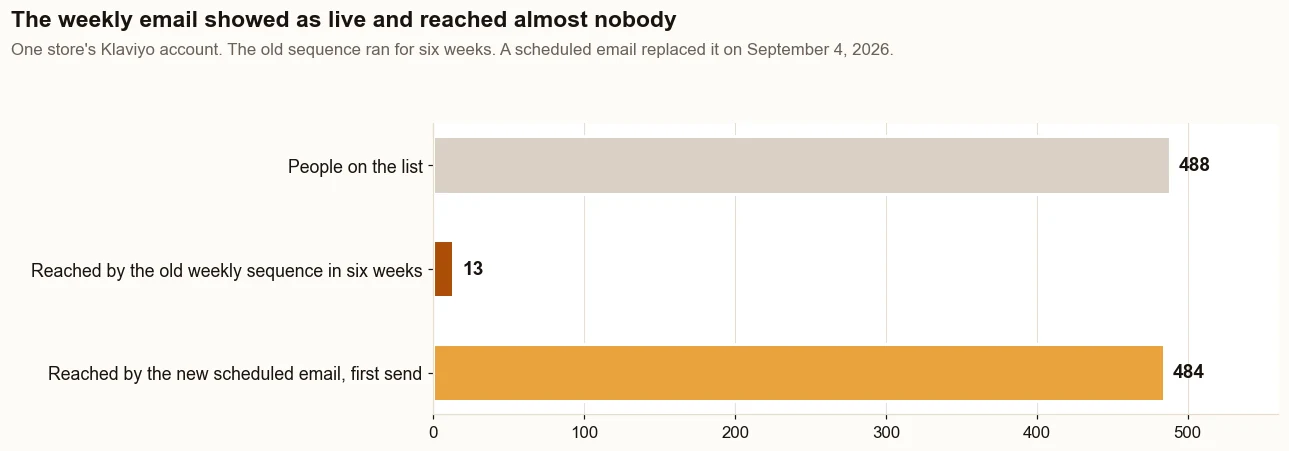
On one store, a weekly sequence meant for 488 people showed as live for six weeks and reached 13 of them. Its trigger, Added to List, only caught people added after the flow went live, and the list came first.
On August 20, 2026, Klaviyo itself showed that 438 of the 488 had received nothing over the previous 30 days. A scheduled weekly campaign replaced it on September 4, 2026 and reached 484 people on its first send, September 8.
The weekly sequence reached 13 people in six weeks while it showed as live. The scheduled email that replaced it reached 484 on its first send. Source: the store’s Klaviyo account.
Klaviyo cannot email people it has never identified, and it cannot grade its own results neutrally. Both limits matter more than any feature list.
It can only reach people it knows
Flows start when a known person does something. At Klaviyo’s own K:BOS 2026 conference, a session reported that over 95 percent of site traffic arrives anonymously, per Klaviyo’s write-up of the event.
“Solve identification first, since a better flow only helps once you know who it's reaching.”
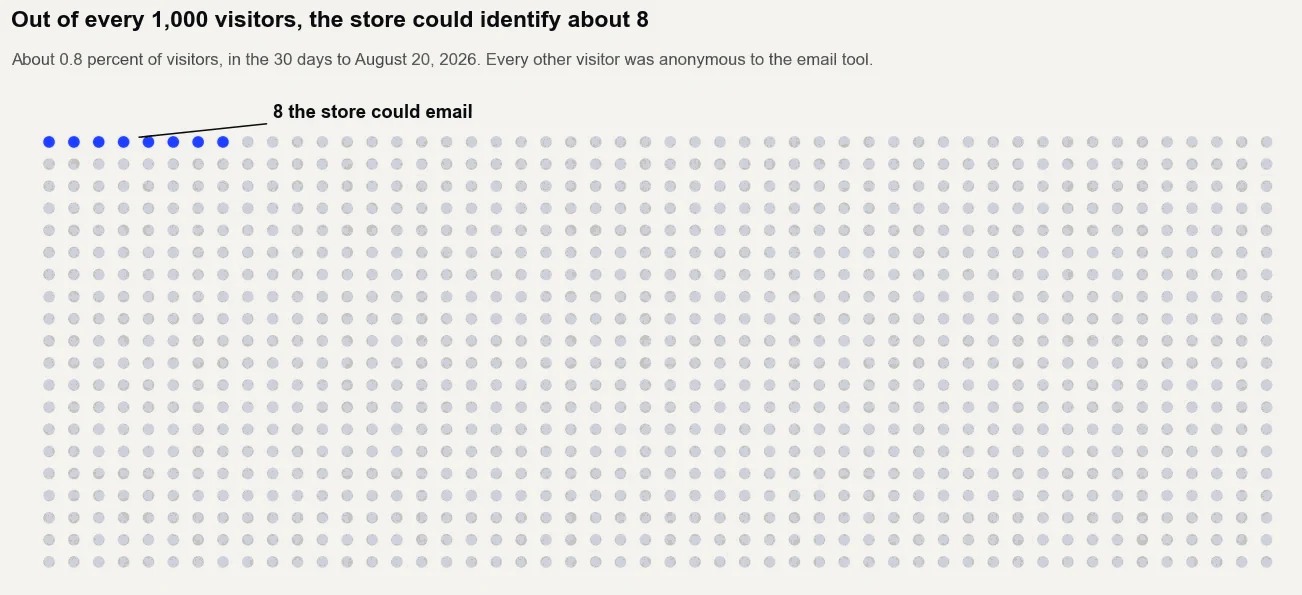
One store’s numbers match that. Over the 30 days to August 20, 2026, it could identify about 0.8 percent of its visitors, so browse abandonment had almost no one to email. More in why browse abandonment gets no orders.
About 8 in every 1,000 visitors could be emailed, in the 30 days to August 20, 2026. Source: Klaviyo’s Active on Site metric against Shopify sessions.
It credits itself generously
Klaviyo counts an order when someone opened or clicked a message and then bought within its attribution window. That window is five days for email by default on newer accounts, according to Klaviyo’s conversion tracking guide, and by default an automatic Apple Mail open can count. That is also why open rates run so high.
For August 17 to September 15, 2026, Klaviyo credited that store’s email with 23 orders. Shopify’s Total sales by referrer report traced 10 to an email click. Both are defensible; read them side by side.
It does not give you an email address
Klaviyo sends from an address you supply. Klaviyo’s sender guide says to use one on your own domain, and warns that a Gmail, Yahoo or other free address can land your messages in spam.
Replies go to the reply-to address you set, and Klaviyo’s deliverability FAQ says it cannot be removed, so point it at an inbox someone reads. If you want replies inside Klaviyo, its Helpdesk turns support messages forwarded from your own address into tickets.
What does Klaviyo look like inside a real store's account?
It looks like a few flows doing most of the work, and a sign-up form deciding how much work there is. Two accounts, opened and checked by hand in 2026, show the pattern.
Of the 23 orders Klaviyo credited to email on the store in the case study for August 17 to September 15, 2026, most came from flows rather than campaigns. The weekly email was the exception that proved the rule: as a flow it reached 13 people in six weeks, and as a scheduled email it reached 484 on its first send.
On a second store that runs Klaviyo, the September 2026 audit found that the welcome series had reached 3 people over the previous 30 days. Two of them bought, $445 in all, by Klaviyo’s own count.
Three recipients is the real finding. Since September 1, only 10 new profiles had been created in that account, while the store’s cleaned GA4 funnel counted 307 visits over the 60 days to September 18. Almost every visitor left without Klaviyo learning who they were.
That is the platform in one picture. Flows convert when they have someone to send to, and the sign-up form sets that number. A welcome series that converted two of three recipients would have far more to work with once it had thirty.
What it does not prove: $445 is Klaviyo’s attribution, not a figure from the store’s own reports, and two orders from three people is too few to call a rate. The windows differ too, profiles from September 1 and visits over 60 days. Read them as a direction, then check the same numbers in your own account.
Klaviyo review: is it worth it for your store?
For a store that already sells, Klaviyo is worth it when its flows send and the store’s own reports show the orders. Here is a plain review of where the Klaviyo platform earns its keep, and where to watch it.
Where it is strong
Where to watch it
Deep store data: orders, products viewed, checkouts started
The price follows active profiles, including shoppers who never subscribed
Flows that react to each customer’s behavior
A flow can say live and reach almost no one
Segments drawn from real engagement data
Open rates include automatic Apple Mail opens
Email and SMS from one customer profile
Its revenue numbers use its own attribution window
A 4.7 rating from 3,313 App Store reviews
Add-ons such as Personalization cost extra
On the store above, sales from email went from $987 (11% of sales) in the 30 days before any changes (May 5 to June 3, 2026) to $4,308 (18%) in the 30 days about three months in (August 17 to September 15, 2026), by Shopify’s own reports.
One deposit order of $2,080 came 17 minutes after a welcome email click. Without it, email brought in $2,228, still 2 times the starting point. It is one store, and its Facebook ads ran in both periods; the detail is in the case study.
Who are Klaviyo's competitors?
Most stores weigh it against Mailchimp and the messaging tool inside their store platform. Klaviyo’s site also publishes comparisons against Postscript, Attentive, Salesforce and Listrak.
Mailchimp is the closest like-for-like email marketing tool, and each company publishes a comparison page arguing for itself. A comparison written for store owners is in Klaviyo vs Mailchimp, and the wider field is in Klaviyo alternatives.
So what is Klaviyo worth to your store?
So what is Klaviyo, in plain terms? It is the tool that turns your store’s customer data into email and texts that go out on their own. It is worth exactly what Shopify’s reports say it brings in.
When it is working, forms collect names on the pages people visit, every flow reaches the people it was meant for, and every email sale shows up in the store’s own reports. That is Get Names and Get Orders in The Traffic to Sales Method, and it is the job behind Klaviyo email, done for you.
If you are not sure where yours stands, the Traffic to Sales Check reads Shopify, Google and email side by side. Left unchecked, a quiet flow keeps missing the orders it was set up to catch.
The proof, from one store
Straight from the case study, with the source and what it does not prove. See all five results.
Result 2 · Email
Sales from email: $987 to $4,308 in about 90 days
Before the work$987
→
About 90 days in$4,308
4.4x
Baseline: the 30 days before the work began
$987 from 7 orders that came in through an email, 11% of sales, May 5 to June 3, 2026.
The work: what changed
Built welcome, abandoned cart, browse abandonment, win-back and high-ticket follow-up emails in Klaviyo (live July 28). Found that the weekly email only went to people who joined the list after it was switched on, so it reached 13 people in six weeks. Replaced it with a scheduled weekly email (September 4) that reached 484 people on its first send (September 8).
Result: about three months in
$4,308 from 10 orders that came in through an email, 18% of sales, August 17 to September 15, 2026, 4.4 times the baseline.
Evidence source
Shopify Analytics, Total sales by referrer, Klaviyo row, pulled September 18, 2026.
What this does not prove
One deposit order, worth $2,080, was placed 17 minutes after the buyer clicked a welcome email. Without it, email brought in $2,228, still 2 times the baseline. Klaviyo credits email with more, 23 orders for the same dates, because it counts any order placed within days of someone opening or clicking an email.
Test it on your store
In Klaviyo, open each flow and compare recipients over the last 30 days with the size of the list it should reach. Then open Total sales by referrer in Shopify for the same 30 days and find the Klaviyo row. A flow reaching a fraction of its list, or a Klaviyo row near zero, is the place to start.
Want a Klaviyo expert to run it?Klaviyo, done for you. On one store, a month of sales from email went from $987 to $4,308 in about 90 days. I work remotely with Shopify stores across the US.
Straight answers
Questions about this.
What is Klaviyo used for?
Klaviyo is used to collect email addresses and phone numbers, then send email and SMS that react to what each shopper does: welcome series, abandoned cart reminders, post-purchase follow-ups, winback messages and regular campaigns. It connects to your store, so those messages use real order and browsing data.
Is Klaviyo owned by Shopify?
No. Klaviyo is a separate public company that trades on the New York Stock Exchange as KVYO. Shopify made a strategic investment in Klaviyo in 2022, and Klaviyo became the recommended email solution partner for Shopify Plus as part of that partnership.
How much does Klaviyo cost?
Klaviyo costs nothing up to 250 active profiles and 500 emails a month. As of September 2026, its pricing page lists paid email plans from $20 a month for 500 active profiles, rising with the number of people you can email. Texts and add-ons are billed separately.
Is Klaviyo hard to learn?
Setting up is manageable, because Klaviyo ships ready-made flows and templates and runs courses through Klaviyo Academy. The harder part is checking that each flow reaches the people it was meant for. One store's weekly sequence showed as live for six weeks and reached 13 of 488 people.
What is Klaviyo best known for?
Klaviyo is best known for email marketing for online stores: automatic flows and campaigns driven by order and browsing data. Its about page dates email marketing to 2013 and SMS to 2021. It now also sells reviews, a customer data platform, AI agents and customer service tools.
Is Klaviyo a CRM?
Klaviyo calls itself a B2C CRM, meaning a customer database built for brands that sell to consumers, with marketing, analytics and service on top. For a store owner, the useful part is the customer profile: every order, product view and message in one place that email and SMS can act on.
Is Klaviyo necessary for a small store?
Not at the start. Shopify Messaging sends up to 10,000 emails a month at no charge and has templates for welcome, cart, checkout, thank-you and win back messages. Klaviyo earns its extra cost once repeat buyers matter and you need deeper segments, flows and reporting built on one customer profile.
Does Klaviyo give you an email address?
No. Klaviyo sends from an address you supply, ideally on your own domain, and warns that Gmail, Yahoo or other free addresses can land in spam. Replies go to the reply-to address you set, which cannot be removed, and Klaviyo's Helpdesk can turn support email forwarded from your own address into tickets.
Why is Klaviyo so popular?
Because it plugs straight into store data. Orders, product views and checkouts land on each customer profile, so flows and segments can react to what people did. Klaviyo's about page says more than 205,000 brands use it, and it runs email, texts and reviews from one place.
Can Klaviyo email every visitor to a store?
No. Klaviyo can only email people it has identified, usually through a sign-up form, a checkout or a click from an earlier email. At Klaviyo's K:BOS 2026 conference, a session reported that over 95 percent of site traffic arrives anonymously, so capture matters before copy.