Home / Insights / Are Facebook ads worth it for your Shopify store? Do the math first
Sales · 7 min read
Are Facebook ads worth it for your Shopify store? Do the math first
Most stores never run the math on their Facebook ads, even after months of clicks and no sales. Here is how to run it, and what one store found when it did.
The short answer
They are worth it only when they bring in more than they cost, after you pay for the products sold. Add the ad spend and anyone you pay to run the ads, find the sales Shopify credits to Facebook, and subtract product costs. On one store, ad costs came to $1,700 a month, while the whole store sold $9,110 in the 30 days before the work began.
How do you work out whether Facebook ads are worth it?
Most stores never run this math:
Add up what the ads cost in a month, including anyone you pay to run them.
Find the sales Facebook actually brought in, from Shopify's Total sales by referrer report rather than Ads Manager.
Subtract what those products cost you to make, pack and ship.
Compare what is left with the ad cost. If it is smaller, the ads are losing money.
If you have never done this, you do not yet know whether your ads are working.
What is a good ROAS for Facebook ads?
ROAS, or return on ad spend, is the sales you get back for each dollar spent on ads. There is no universal good ROAS. A good one is anything above your break-even, and break-even comes from your own margin.
Divide 1 by your gross margin, the share of each sale left after product, packing and shipping costs. If you keep 40 cents of every sales dollar, you need $2.50 in sales for every $1 of ads just to break even, before any other costs.
Use the sales Shopify credits to Facebook in that math, not the purchases Ads Manager reports, and include what you pay anyone to run the ads.
They can be, but the bar is higher than it was a year ago. In its filing for the three months to June 30, 2026, Meta reported its average price per ad up 12% year over year, so the same budget buys fewer ads than it did.
Triple Whale’s benchmark of more than 40,000 brands using its software put the median cost per 1,000 impressions at $15.06 from August 2025 to July 2026, up 13.24%, and the median return on ad spend at 1.88. At a 40 percent margin, that median sits below the 2.5 needed to break even. It is Triple Whale’s figure for its customers, not a forecast for your store.
If one owner says the ads are broken and another says they have never worked better, both can be right about their own stores. The verdict that counts is the math above, run on your own numbers in Shopify.
What did the math look like on one store?
Line
Amount
Source
Facebook ad spend
$1,200 a month
The store's ad budget
Ad vendor fee
$500 a month
The store's vendor fee
Total cost of the ads
$1,700 a month
Spend plus fee
Whole-store sales, the 30 days before the work began
$9,110
Shopify, May 5 to Jun 3, 2026
Sales Shopify credited to Facebook, same 30 days
$2,415, unpaid posts included
Shopify, Total sales by referrer
Even before product costs, the ads cost more than the sales Shopify credited to Facebook in those 30 days. The ads were carrying that store, and costing it money.
Why do Facebook ads get clicks but no sales?
Owners describe the same pattern again and again: the ads drive clicks, the sessions climb and nobody buys. That usually means the ads are reaching people who were never going to buy, or the store is losing them after the click. Shopify traffic but no sales shows how to tell which.
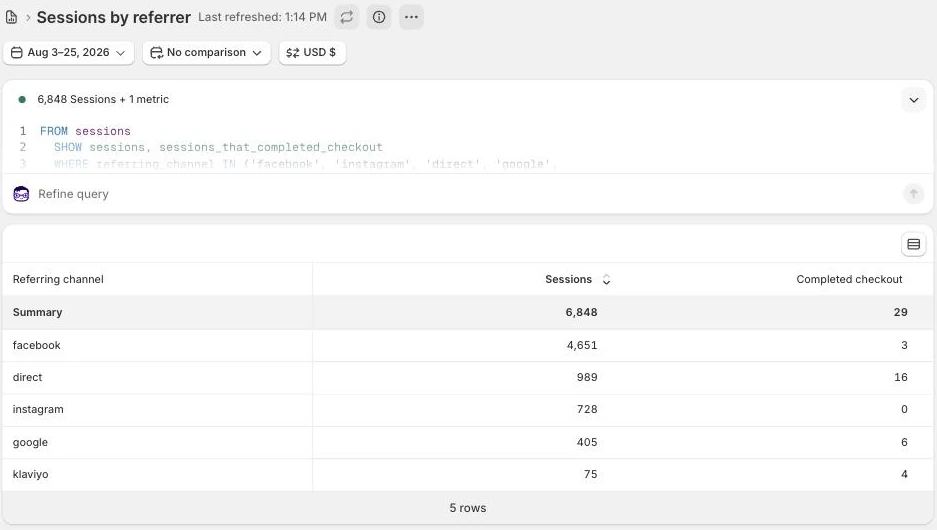
Ads Manager can still report purchases, because it gives ads credit using its own attribution settings, the rules for how long after someone sees or clicks an ad a purchase still counts. Shopify's sales by referrer report is the tiebreaker. On that store, 23 days of cold Facebook campaigns in August 2026 produced 5,379 visits from Facebook and Instagram and 3 completed checkouts.
Good-looking ad numbers do not settle it either. A strong click-through rate and a few add to carts show interest, and Meta’s own guidance is to focus on the optimization event you chose, such as purchases. When visitors add to cart and still do not buy, look at the store: Shopify conversion rate optimization covers what to fix first.
Why do Ads Manager and Shopify report different sales?
They count different things. Meta's help center says Ads Manager credits results using the attribution model and settings chosen for each ad set, which are the rules for which ad gets credit. So a purchase can be credited to an ad someone saw or clicked days earlier.
Shopify credits the channel a buying visit actually came from. Neither is lying, but only Shopify's number is the store's own record, and it is the one to put in your profit math.
Google search brought in more than 3.5 times the sales of the paid ads, from under a fifth of the traffic.
Source: Shopify’s sales attribution report for the 90 days before September 3, 2026. Google search brought $8,316 in sales and paid Facebook and Instagram $2,322, as charged. What it does not prove: the report credits each order to the visit it came from, so an ad that first introduced a buyer who later searched Google gets no credit.
Should you fix Google's free listings before spending more on Facebook?
Facebook ads
Google free listings
Cost per click
Paid, set by the ad auction
None
Who sees it
People the ad targets
People searching for the product
When it stops
When the budget stops
When the product is unpublished or disapproved
Where the order shows in Shopify
Facebook or Instagram in Total sales by referrer
Google, with srsltid (a tag Google adds to the link) on the landing page when auto-tagging is on
On the store in the case study, the ads ran in both the before and after periods, and sales from Google went from $354 to $5,418, by Shopify’s own reports.
How do you make Facebook traffic visible in Shopify?
Add UTM parameters to every ad link. These are short tags at the end of a link that tell Shopify where a visit came from, for example a source of facebook and a medium of paid. Shopify's marketing reports attribute visits that carry a campaign parameter to marketing, which separates paid clicks from people who arrive from unpaid posts.
Without tags, paid and unpaid Facebook visits blur together, and the ads either get credit for the store's own posts or lose credit for their own clicks.
The same tags help Google Analytics credit the right channel, as setting up GA4 on Shopify explains.
How do you know the ads are carrying the store?
Sales drop when you turn the budget down.
Free Google listings, search and email bring in a small share of sales.
Nobody can tell you which channel actually paid last month.
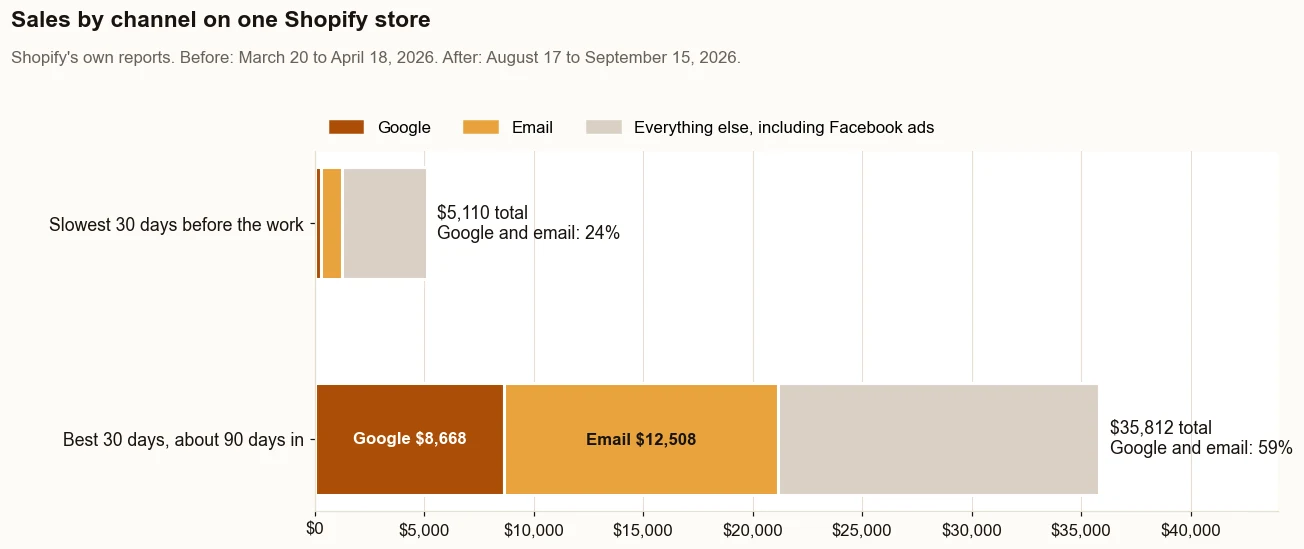
On that store, Google and email were 15% of sales in the 30 days before the work began.
Do warm audiences work better than cold audiences?
They did on that store. A cold audience is people who have not interacted with the brand. A warm audience is people who already visited the site or engaged with it. On August 26, 2026 the ads moved to warm audiences:
Cold audiences
Warm audiences
Dates
August 3 to 25, 2026
August 26 to September 15, 2026
Cost per website visit, Facebook Ads Manager
45¢
13¢
Visits from Facebook and Instagram, Shopify
5,379
3,589
Completed checkouts, Shopify
3
20
Visits per completed checkout
1 in 1,793
1 in 179
Warm audiences are smaller and wear out, so this will not hold at any budget, and Shopify's Facebook visits include unpaid posts. The full receipt, including what it does not prove, is in the case study.
Is $10 a day enough for Facebook ads?
The daily number matters less than who sees the ads. That store's ad budget was $1,200 a month, about $40 a day, and 23 days of cold campaigns in August 2026 still produced only 3 completed checkouts from 5,379 visits. After the ads moved to warm audiences, 1 in 179 visits completed checkout instead of 1 in 1,793.
It depends on two numbers from your own accounts: what a website visit costs in Ads Manager, and how many visits it takes to get one completed checkout in Shopify. Divide the budget by the cost per visit, then divide that by the visits per checkout, and you have a rough count of the orders the budget can buy.
On one store, cold audiences took 1,793 Facebook and Instagram visits for each completed checkout (August 3 to 25, 2026). Warm audiences took 179 (August 26 to September 15, 2026). At the cold rate, a small budget buys visits, not orders.
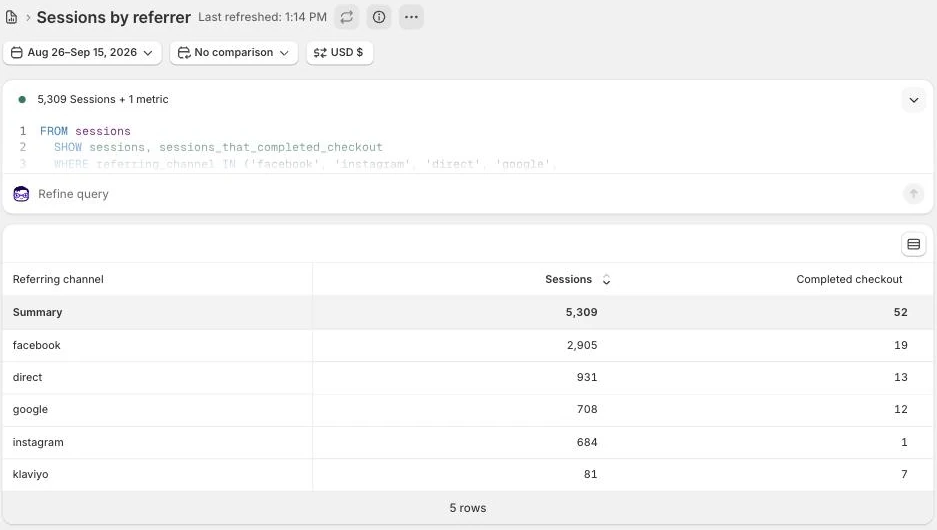
Shopify’s Sessions by referrer report for the cold-audience weeks (August 3 to 25, 2026), filtered to five channels: facebook and instagram together, 5,379 visits and 3 completed checkouts. Store name redacted.The same report for the warm-audience weeks (August 26 to September 15, 2026): 3,589 visits and 20 completed checkouts. Store name redacted.
What changed, and what did not?
The ads were not switched off. On August 26, 2026 they moved to warm audiences. A website visit went from 45¢ to 13¢ in Facebook Ads Manager, 71% less.
What changed around them: the best products were published to Google's free listings, the email flows were rebuilt so they actually send, and every order was checked against the channel that brought it. Google and email went from 15% of sales in the 30 days before the work began to 41% in the 30 days about three months in.
Google and email went from 15% of sales to 41%. Source: Shopify’s own reports. What it does not prove: this is one store, and the Facebook ads ran in both periods.
When should you pause or move Facebook ad spend?
Pause or shrink it when Facebook's sales in Shopify, after product costs, stay below what the ads cost month after month.
Move it to warm audiences when cold campaigns send large numbers of visits that almost never reach checkout.
Keep it when the math holds and the free channels are already doing their share, so the ads are a choice instead of the whole plan.
What mistakes make Facebook ads look better than they are?
Judging results in Ads Manager instead of Shopify’s Total sales by referrer report.
Ad links without UTM tags, so paid and unpaid Facebook visits blur together.
Leaving product, packing and shipping costs out of the math.
Leaving the vendor fee out of the ad cost.
Raising the budget before the math holds at the current one.
So, are Facebook ads worth it?
They are worth it when the math says so, and only you can run it on your store. The better question is whether the store depends on them more than it should. When the free channels are working, the ads become a choice instead of the whole plan.
Straight from the case study, with the source and what it does not prove. See all five results.
Result 5 · Facebook
Facebook: 45¢ to 13¢ a visit, and 10 times the checkouts per visit
Cold, Aug 3 to 25, 20261 in 1,793
→
Warm, Aug 26 to Sep 15, 20261 in 179
10x
Baseline: cold audiences, before the switch
Cold-audience campaigns, August 3 to 25, 2026: 45¢ per website visit. Shopify logged 5,379 visits from Facebook and Instagram and 3 completed checkouts, 1 in 1,793 visits.
The work: what changed
Moved the budget to warm audiences, people who had already visited the store or engaged with the brand, with a single box offer (from August 26).
Result: warm audiences, after the switch
13¢ per website visit, 71% less. Shopify logged 3,589 visits from Facebook and Instagram and 20 completed checkouts, 1 in 179 visits, 10 times the rate on cold audiences.
Evidence source
Shopify’s Sessions by referrer report for the cold-audience weeks (August 3 to 25, 2026), filtered to five channels: facebook and instagram together, 5,379 visits and 3 completed checkouts. Store name redacted.The same report for the warm-audience weeks (August 26 to September 15, 2026): 3,589 visits and 20 completed checkouts. Store name redacted.Cost per visit: Facebook Ads Manager. Visits and checkouts: Shopify Analytics, sessions by referrer with completed checkouts, pulled September 18, 2026.
What this does not prove
Both periods fall inside the work, so this proves the switch, not a gain over the ads that ran before June. Facebook visits have converted anywhere from 1 in 71 (March 2026) to 1 in 811 (December 2025). Warm audiences are smaller and wear out, and Shopify's Facebook visits include unpaid posts. The periods are 23 and 21 days.
Test it on your store
In Shopify, open Sessions by referrer and Total sales by referrer for your last 30 days, and divide Facebook's orders by its sessions. In Ads Manager, compare cost per landing page view on cold ad sets and retargeting ad sets. Thousands of visits and a handful of orders means the ads are buying visits, not buyers.
Only when they bring in more than they cost after you pay for what you sold. Add the monthly ad spend and anyone you pay to run the ads, set it against the sales Shopify credits to Facebook, and subtract product costs.
Why do Facebook ads get clicks but no sales?
Usually because the ads reach people who were never going to buy. On one store, 23 days of cold Facebook campaigns in August 2026 produced 5,379 visits from Facebook and Instagram and 3 completed checkouts.
Do warm audiences convert better than cold audiences on Facebook?
They did on that store. After the budget moved to people who had already visited or engaged, 1 in 179 Facebook and Instagram visits completed checkout, against 1 in 1,793 on the cold campaigns.
Does advertising on Facebook really work?
It can, when it reaches people likely to buy and you judge it with Shopify's own reports. On one store, 1 in 1,793 visits from cold campaigns completed checkout, against 1 in 179 from warm audiences. Whether that makes money still depends on ad cost and product cost.
What is a normal success rate for Facebook ads?
There is no average worth trusting across stores. On one store, the share of Facebook and Instagram visits that completed checkout ranged from 1 in 71 in March 2026 to 1 in 811 in December 2025. Measure your own rate in Shopify before comparing it with anyone else's.
Why did my Facebook ads suddenly stop working?
Two causes Meta documents are the first things to check. Its delivery system uses the highest volume, lower cost opportunities first and may move to more expensive ones as they run out, and an audience that sees the same ad too many times becomes less likely to engage. Judge a full week in Shopify before changing anything.
How long should you test Facebook ads before deciding?
At least a full month, judged in Shopify. Meta says an ad set usually leaves its learning phase after about 50 results in the week after its last significant edit, and results are less stable until then. A $100 test would need purchases at $2 each to reach 50, so it can show interest, not whether the ads pay.
Is it worth starting Facebook ads if the store already sells without them?
Only if you can measure the result and afford the test. Tag every ad link, set a monthly budget you can live without, and judge the orders Shopify credits to Facebook against the break-even math, after product costs. If those orders cost more than they earn, keep growing the free channels that already sell.