Home / Insights / Google Ads vs Facebook ads: which works for a Shopify store?
Sales · 16 min read
Google Ads vs Facebook ads: which works for a Shopify store?
Both platforms will take your budget. Only one reaches buyers who are already looking for you. Here is how each prices, targets and reports, which one to start with on a small budget, and how to judge both with Shopify's numbers instead of their own.
The short answer
Google Ads vs Facebook ads comes down to intent. Google shows your products to people already searching for them, while Facebook and Instagram find people who were not looking yet. For a Shopify store that already sells, publish the catalog to Google's free listings first, then judge both paid channels by the orders Shopify credits to each.
Google Ads vs Facebook ads: what is the difference?
Google Ads answers a search. Facebook ads interrupt a scroll. That one difference in intent, whether the buyer is looking for you or not, drives almost everything else: what the ads charge, who sees them and how each platform reports what it sold.
Google Ads is Google's advertising platform. It places ads on Google's search engine, in Google Shopping, on YouTube and across the Google Display Network, which Google describes as a large collection of websites, mobile apps and video content. Facebook ads are Meta's advertising, shown on Facebook, Instagram, Messenger and Meta Audience Network and bought through Meta Ads Manager.
Google Ads
Facebook ads
What starts the ad
A search, matched to your keywords or to your Merchant Center product data
Meta's estimate of who will respond, plus any audience you choose
The buyer's state of mind
Looking for something specific
Scrolling, not searching
How you usually pay
Per click
Per impression, unless you choose otherwise
How the auction ranks ads
Ad Rank: bid, ad and landing page quality, thresholds, competition, search context and ad assets
Total value: bid, estimated action rates and ad quality
How far a daily budget can stretch
Up to 2 times the average on a day, 30.4 times in a month
Up to 75% over on a day, 7 times in a week
Best at
Catching demand that already exists
Creating demand that did not
What its own dashboard counts
Conversions by Google's tracking
Purchases by Meta's attribution settings, which can include views
The rest of this guide takes those rows one at a time, then shows how to compare the two with your store's own numbers.
How does Google Ads work for a Shopify store?
Google runs an auction every time someone searches and ranks ads by Ad Rank. Google's help center on Ad Rank says it runs different auctions for each ad location on the page. It scores ads on six factors: your bid, the quality of your ad and landing page, the Ad Rank thresholds, how competitive the auction is, the context of the search and the expected impact of your ad assets.
With CPC bidding, short for cost per click, you pay for each click on your ads. The actual CPC, the final amount charged for a click, is often lower than your maximum bid. You only pay what is needed to clear the thresholds and beat the ad ranked just below yours.
Search ads
Search ads are text ads that show near search results when someone searches with terms related to your keywords, according to Google's page on the Search Network. They suit items people search for by a specific name, type or model.
Shopping ads and Performance Max
For a store selling physical goods, Shopping is the format that shows the goods themselves. Google's Shopping ads page says these ads use your existing Merchant Center product data, not keywords, to decide how and where to show your ads. They show a photo, title, price and store name before anyone clicks.
Performance Max is a goal-based campaign that reaches YouTube, Display, Search, Discover, Gmail and Maps from a single campaign. Shopify's Performance Max page says Performance Max replaced Smart Shopping campaigns, and that a store creates them in Google Merchant Center, reached from the Google & YouTube channel in the Shopify admin.
Either way, the feed is the ad. A feed Google cannot read well means weak paid ads and weak free listings from the same data.
Display and YouTube
Display ads appear across the Google Display Network, and video ads run on YouTube. Both reach people who are not searching at that moment, which puts them closer to Facebook ads in intent than to Search.
How do Facebook ads work for a Shopify store?
Facebook ads also run through an auction, one each time there is a chance to show someone an ad. Meta's auction page says the winner is the ad with the highest total value, a mix of the bid, Meta's estimate of whether this person will act, and ad quality. Meta's billing page says advertisers are usually charged by impression.
Targeting is increasingly Meta's job. Meta's Advantage+ audience uses Meta's AI to find the audience, drawing on past conversions, Meta Pixel data and interactions with previous ads. Meta says its models look for the right message, for the right audience, at the right time, and it recommends testing Advantage+ audience for almost all campaign types except retargeting.
“Advantage+ end-to-end solutions continued to grow, reaching over $75 billion in annual revenue run-rate”
With the targeting automated, a store's levers on Facebook are the offer, the creative and the data it shares with Meta.
That data comes through Shopify's Facebook and Instagram channel. Shopify's data sharing page sets out the choice. At the Standard level, a Meta pixel collects browsing data, and a browser ad blocker can stop it.
At Enhanced and Maximum, the Conversions API also sends the purchase event server to server, which ad blockers cannot block. Shopify also reminds stores to explain what they share in their privacy policy.
How do the targeting options compare?
Google targets the moment; Facebook targets the person. Google users tell the platform what they want in the search box. Facebook and Instagram users tell it nothing when the ad appears, so Meta has to predict.
On Google, the search itself is the main signal. When it works out Ad Rank, Google checks the search terms, the person's location at the time, the device and the time of the search. Display campaigns can add targeting signals to find audience segments, according to Google's page on Display targeting.
On Facebook, the audience is the main signal. Meta's pricing page advises broadening audience targeting, noting that ad sets with an audience of at least 2 million people often see better performance. And reach is rarely the limit: Meta reported 3.60 billion daily active people across its apps on average in June 2026.
Targeting
Google Ads
Facebook ads
Main signal
The search: words, location, device and time
The person: Meta's estimate of who will act
Past visitors
Remarketing lists, which Smart Bidding uses to adjust bids
Retargeting campaigns, which Meta leaves out of its Advantage+ audience advice
People not yet looking
YouTube and the Display Network
Every placement, and Meta's Awareness objective, built to raise awareness of your business
Where the ads appear
Search, Shopping, YouTube, Display, Discover, Gmail and Maps
Facebook, Instagram, Messenger and Meta Audience Network
On social media, users are scrolling past posts, not typing what they want. That is why a Facebook ad has to earn attention, while a Google ad only has to match what someone asked for.
Which costs less, Google Ads or Facebook ads?
Neither, in general. The two advertising platforms charge for different things, so a cheaper click or a cheaper thousand impressions says little about a cheaper order. Google usually bills per click, and Facebook usually bills per impression.
Triple Whale's benchmark of more than 40,000 brands put the median Meta CPM at $15.06 from August 2025 to July 2026, up 13.24%. Google prices move with each search term and category, so your own account is the only reliable figure there.
How each one spends a daily budget
Both let a single day run over the average. Google's help center says a campaign can spend up to two times its average daily budget on a given day, but no more than 30.4 times it in a month. Meta's help center says Facebook can spend up to 75% over on a given day, but no more than 7 times the daily amount in a calendar week.
$20 average daily budget
Google Ads
Facebook ads
Most on a single day
$40
$35
Most over a longer period
$608 in a month
$140 in a calendar week
The number that decides it
What each order costs, counted in Shopify. Put each channel's total bill, fees included, over the orders Shopify credits to it for the same dates. The full breakdown of Facebook ad prices walks through the Meta side, and the ROAS math turns the result into a break-even test.
Which works better on a small budget, Google Ads or Facebook ads?
On a small budget, the deciding factor is how many results each platform’s automation needs before it settles, and a small spend may not buy enough for either. Start with Google’s free listings, which cost nothing per click, then test one paid channel on your best sellers.
If you have read that Google wins, then that Facebook wins, and your own results match neither, that is because each verdict comes from someone else’s store. The thresholds below are the platforms’ own:
Before the automation settles
Google Ads
Facebook ads
Results it needs
Target ROAS needs at least 15 conversions in the past 30 days for Search and Shopping campaigns
An ad set usually leaves the learning phase after about 50 results in the week after its last significant edit
At a made-up $40 per order
About $600 over 30 days
About $2,000 a week
A Facebook ad set that cannot reach those results shows as Learning limited in Ads Manager. For smaller budgets, Meta’s advice on minimum budgets is to optimize for an event that is easier and cheaper to achieve, such as landing page views, instead of purchases.
Google’s bar is lower, and it bills by the click, so a small test on a few best sellers that people already search for can learn from fewer orders. Neither replaces the free listings, which cost nothing per click, whatever you spend.
Which one reaches buyers with more intent?
Google, because the buyer starts it. Someone searching for a style, a size or a brand is further along than someone scrolling a feed. Google's Shopping ads page makes the same point: a shopper who clicks a Shopping ad has already seen the photo and price, which puts them further down the purchasing funnel than the average web user.
That intent has a catch. Shopify's ROAS guide notes that a high ROAS on Google search may come from customers who had already decided to buy. Brand searches, people typing your store's name, are the clearest case: some of those buyers would have found you without the ad.
Facebook's strength is the other end. It can put something new in front of people who did not know it existed, and bring back visitors who left without buying. That is demand creation, and it is worth paying for when Shopify shows those introductions turning into orders later.
Why should free listings come before either budget?
Because Google will show your products without charging per click, and the same catalog data feeds both the free listings and the paid Shopping ads. As of September 2026, Google's Merchant Center help says free listings can appear, without charge, on Google Search, Google Maps, Gemini, YouTube, the Shopping tab, Google Images and Google Lens.
“search results on the Google Shopping tab will consist primarily of free listings”
That announcement also said paid campaigns could now be augmented with free listings. The two still run on the same Merchant Center data, so a store that fixes its feed improves both at once.
Shopify makes the first step simple. Shopify's Google & YouTube channel syncs products to Google Merchant Center, and for eligible stores selling in the United States, synced products can show in Google Shopping tab listings for free.
One direct to consumer store on Shopify ran Facebook ads before and during the work, while its free Google channels grew beside them. Shopify's sales attribution report for the 90 days before September 3, 2026 put the two biggest sources of visits side by side.
Shopify attribution report, 90 days before September 3, 2026
Visits
Orders
Sales
Google search, not paid
1,720
24
$8,316
Paid Facebook and Instagram
9,214
9
$2,322
Google search brought more than 3.5 times the sales from under a fifth of the traffic. What it does not prove: the report credits each order to the visit it came from, so an ad that first introduced a buyer who later searched Google gets no credit.
Sales from Google, organic search and free listings together, went from $354 in the 30 days before the work began (May 5 to June 3, 2026) to $5,418 in the 30 days about three months in (August 17 to September 15, 2026), by Shopify's own reports. It is one store, the Facebook ads ran in both periods, and Shopify does not split Google search from free listings.
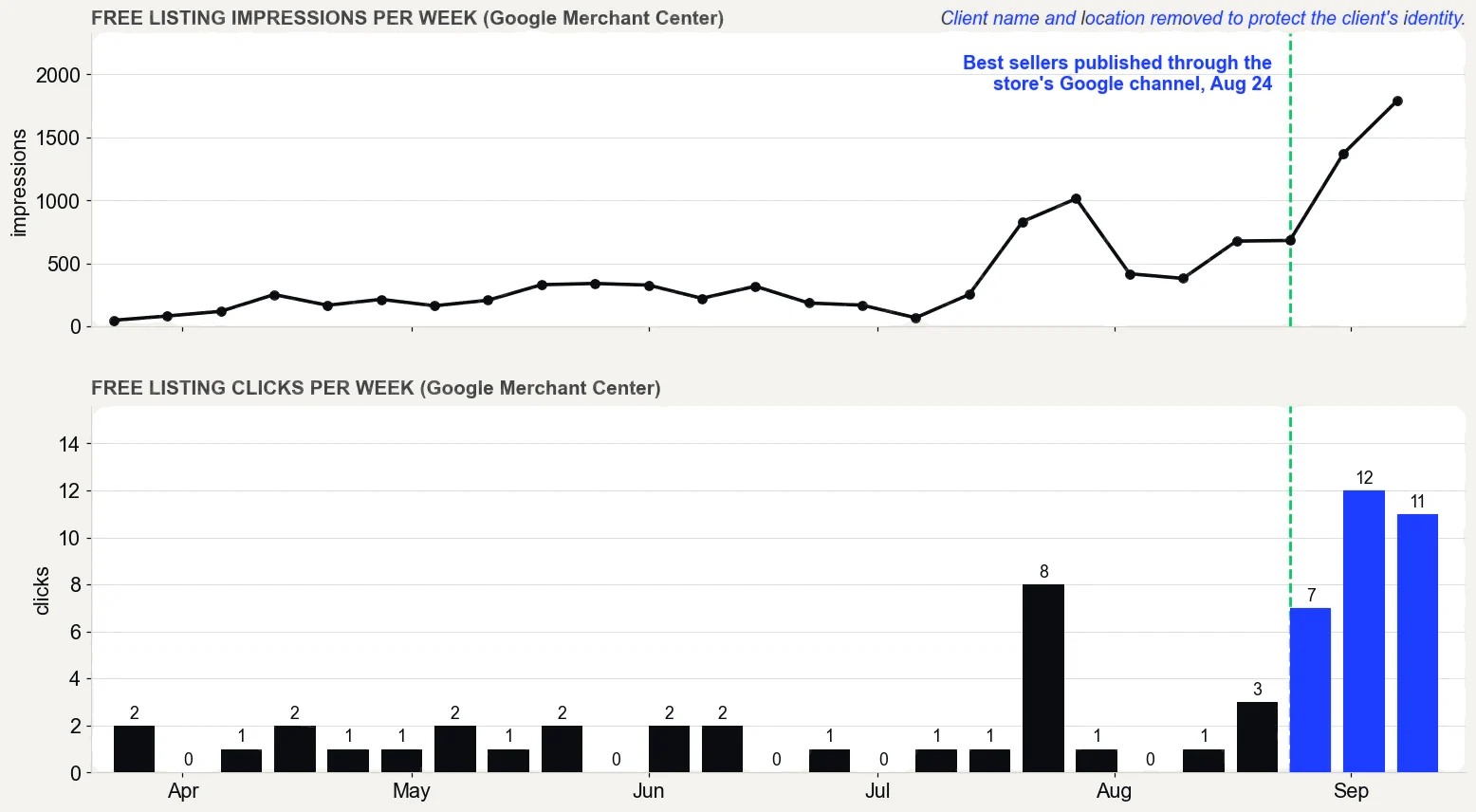
The free listings were small but moving. In Merchant Center's performance report, free listings only, clicks went from 5 on 562 impressions (May 5 to June 3, 2026) to 34 on 5,026 (August 17 to September 15, 2026).
The best sellers were published through Shopify's Google & YouTube channel on August 24, 2026. Before that, Google had shown thin versions it found on its own.
Google Merchant Center performance report, free listings only, pulled September 16, 2026. What it does not prove: the product pages were rewritten in the same weeks, so not all of the change comes from publishing, and free listing clicks are still small numbers.
“Paid Media typically delivers a minority of the incremental business revenue.”
On this store, Google and email, which do not bill per click, went from 15% of sales in the 30 days before the work began to 41% in the 30 days about three months in. Check whether the same holds on yours before moving a dollar; the full receipts are in the case study.
How do you compare Google Ads and Facebook ads fairly?
In Shopify, for the same dates, by the same rules. Each platform counts its own sales its own way.
Meta's attribution settings can credit a purchase made within a day of someone simply seeing an ad, and Google counts conversions by its own tracking. Each is grading its own homework.
Tag every ad link. Add UTM parameters, short tags at the end of a link, so Shopify can tell paid Google, paid Facebook and unpaid posts apart.
Pick the same dates for both. Use at least a full month, so one slow week does not decide it.
Pull orders and sales from Shopify. Use the Total sales by referrer report, which shows the last interaction referrer, for both channels.
Put every charge on top. Ad spend, fees and any location fees, from each platform's billing.
Divide. Work out what each order costs, and the ROAS, for each channel from Shopify's numbers.
Check who introduced the buyer. Switch to a first click model in Shopify's marketing reports to see which channel brought people in the first time.
When the demand already exists and the catalog data is ready for it. The signs:
People already search for what you sell. A style, a size, a model or a brand with steady searches.
Your feed is clean. Titles, prices, images and availability in Merchant Center match the store, so Shopping ads and free listings both work.
Your margin covers the clicks. Multiply the price of a click by the visits it takes to win an order. If that is more than an order earns, the ads lose money.
You want to capture demand, not create it. Google is at its best when the buyer is already looking.
When the demand does not exist yet, or when the job is bringing people back. The signs:
Nobody searches for it yet. A new item, or a new kind of item, has no search demand to capture.
It sells on sight. Things that show well in a photo or a short video suit a feed.
You want visitors back. Retargeting people who visited and left is where Facebook is often cheapest.
You want names, not only orders. A sign-up offer turns strangers into an email list you can reach for free later.
Watch what each introduction costs. On one store, cold audiences ran 45¢ per website visit in Meta Ads Manager and warm audiences 13¢, and the two behaved very differently at checkout, as the Facebook break-even math shows.
What should a store fix before paying for either?
The things both advertising channels depend on. Paid clicks land on the same store, so fix what they land on first:
The catalog in Merchant Center. Publish your best sellers through Shopify's Google & YouTube channel and clear any disapprovals or account issues, such as a misrepresentation suspension.
The product pages. Clear titles, real photos, prices and shipping charges a buyer can see before checkout. Product page fixes help paid and free visits alike.
Tracking. Set up conversion tracking for Google, choose a Meta data sharing level, and put UTM tags on every ad link.
A way to collect names. A sign-up form on the pages that get visits, so paid visitors who do not buy can still be reached by email.
A monthly check. Compare each channel in Shopify's reports every month, not in each platform's dashboard.
A store that skips this list pays twice: once for the click, and again for the order it loses after the click.
Should you run Google Ads and Facebook ads together?
Yes, once each has earned its place in Shopify's reports. They do different jobs: Facebook introduces, and Google catches the search that follows. A buyer who first saw a Facebook ad and later searched Google shows up as a Google order in a last click report.
That is why the first click view matters when you run both. If Facebook keeps showing up as the first channel for buyers who later order through Google, it is doing a job the last click report hides. If it does not, the money may do more on Google, or on email and free listings.
Facebook ads vs Google Ads for ecommerce: which sells more?
There is no general winner, only your store's numbers. Triple Whale reported that brands using its software put 66.88% of their total ad budget on Meta from August 2025 to July 2026. That shows where the money goes, not which channel sells better for any one store.
Are Meta ads the same as Facebook ads?
Yes. Meta is the company behind Facebook and Instagram, and Meta ads are the same ads, bought in Meta Ads Manager and shown across Facebook, Instagram, Messenger and Meta Audience Network. Comparing Google Ads with Meta ads is the same comparison as Google with Facebook.
Instagram placements are part of the same campaign and the same budget. Judge Facebook and Instagram together in Shopify's reports, since they share the same campaigns.
Which one should a store that already sells pick first?
Neither, until Google shows your products for free. The Google Ads vs Facebook ads choice matters less than the order you do things in: free listings and search first, then the names and emails that turn visitors into orders, then paid ads measured in Shopify.
That order is The Traffic to Sales Method: a Traffic to Sales Check, then Get Found, Get Names, Get Orders and Show Proof. When it works, the ads are a choice you make each month, and Google and email bring in orders that do not bill per click.
Straight from the case study, with the source and what it does not prove. See all five results.
Result 3 · Google
Sales from Google: $354 to $5,418 in about 90 days
Before the work$354
→
About 90 days in$5,418
15x
Baseline: the 30 days before the work began
$354 from 2 orders that came in from Google, May 5 to June 3, 2026. The highest-value products in the catalog had never been published through the store's Google channel.
The work: what changed
Rewrote product names, titles, descriptions and search snippets around the terms buyers search, with real weights (August 7 to 30). Built six city landing pages (August 1 and 2). Published the store's highest-value products to the Google channel so they could show in free Shopping listings (August 24). Cleaned up crawl errors and expanded thin product pages to more than 400 words (August 27 to 30).
Result: about three months in
$5,418 from 17 orders that came in from Google, August 17 to September 15, 2026, 15 times the baseline.
Evidence source
Shopify Analytics, Total sales by referrer, Google row, pulled September 18, 2026.
What this does not prove
Shopify does not split Google search from free Shopping listings, so this cannot say which sold more. Four of the 17 orders were deposit orders, worth $2,070. Google Search Console only started collecting data on July 28, 2026, so there are no clicks from before the work to compare.
Test it on your store
In Shopify, open the Google and YouTube channel and check that your best sellers are published to it. In Search Console, open Performance, sort queries by impressions, and note the ones in positions 5 to 15. Then compare the Google row in Total sales by referrer for your most recent 30 days with the 30 days before your last change.
Google Ads vs Facebook ads: which is better for a Shopify store?
Neither is better in general. Google Ads suits products people already search for, and Facebook ads suit products people need to discover. For a store that already sells, publish the catalog to Google's free listings first, then compare both paid channels by what each order costs in Shopify's own reports.
Are Google Ads really worth it?
They are worth it when the orders Shopify credits to them earn more than the ads charge. Search and Shopping ads reach people already looking, which helps, but brand searches can bill you for buyers who would have found you anyway. Check what each order costs in Shopify before raising the budget.
Is $20 a day good for Google Ads?
It can be a start. Google lets a campaign spend up to twice its average daily budget on a single day and up to 30.4 times it in a month, so $20 a day means up to about $608 a month. Divide that by what an order costs you in ads to see how many orders it can buy.
Is $10 a day enough for Google Ads?
For a small test, yes. For automated bidding, often not. Google's Target ROAS strategy needs at least 15 conversions in the past 30 days for Search and Shopping campaigns. At $10 a day, about $304 a month, each order could use no more than about $20 of ad spend.
How much do 1,000 clicks cost on Facebook?
About $870, at the average cost per click of 87 cents that Shopify's Facebook ads report gave for November 2025. That is an average across advertisers, not a price. Your own CPC depends on your audience, placements and the time of year, and Facebook usually bills by impression anyway.
Is $500 a month enough for Google Ads?
It depends on what a click costs for your products and how many clicks it takes to win an order. Divide $500 by your average CPC, then by the clicks per order. If the answer is a handful of orders, fix the product feed and free listings first so Google also sends free clicks.
Can you run Google Shopping ads from Shopify?
Yes. Shopify's Google and YouTube channel syncs products to Google Merchant Center, and Shopify's help center says Performance Max campaigns are created in Merchant Center, reached from that channel in the Shopify admin. The same synced products can also show in free listings for eligible stores in the United States.
Should a Shopify store run Google Shopping or Search ads first?
For most stores selling physical products, Shopping. Shopping ads use Merchant Center product data instead of keywords and show a photo, title and price before the click. Search ads fit products people search for by exact name or model. Both depend on a clean feed and landing pages that match it.
Can Google ads show in AI Overviews and AI Mode?
Yes. Google's help center says text and Shopping ads from existing Search, Shopping and Performance Max campaigns are eligible to show within AI Overviews, and you cannot opt out. In May 2025, Google said the same campaign types, with Search on broad match, would be eligible for AI Mode. Google Ads does not yet report AI Overviews placements separately.
How should you split a small budget between Google and Facebook?
There is no correct split, only your store's numbers. Brands using Triple Whale's software put 66.88% of their ad budget on Meta from August 2025 to July 2026, which shows where the money goes, not what sells. Start with one channel, measure what each order costs in Shopify for a month, then move money toward the cheaper orders.