Home / Insights / Is Shopify worth it in 2026? The math for a store that sells
Sales · 17 min read
Is Shopify worth it in 2026? The math for a store that sells
If ads carry your store, the bills keep climbing and no two answers about Shopify's real cost agree, it is fair to ask whether the platform is the problem. Here are the real 2026 prices, and the math that shows where the money actually goes.
The short answer
Is Shopify worth it? For most stores that already sell, yes. As of September 2026, Shopify's Basic plan is $39 a month billed monthly, and an online card payment costs 2.9% plus 30 cents through Shopify Payments, or $3.20 on a $100 order. For a store whose ads carry it, the bigger cost is the traffic.
For a store that already sells, usually yes. Shopify’s subscription and card charges are a small, predictable share of revenue. In return you get the store, the checkout, hosting, reports and the core tools businesses use to sell online.
For a store that runs on ads, the expensive line is somewhere else. It is traffic. If every order starts with a paid click, the ad bill grows with the business while the platform bill barely moves.
Before the work began, one store in the case study paid $1,700 a month for Facebook ads: $1,200 in ad spend and $500 to a prior vendor. Shopify’s entry subscription is $39 on monthly billing.
So the useful question is bigger than whether Shopify is worth it. It is whether your store can win orders without paying for each one. A store should not have to pay for every sale, and the platform is rarely what forces it to.
Shopify is not the right answer for everyone. If you sell a few items a month, a marketplace with no subscription can cost less.
If you need checkout changes that only Shopify Plus allows, the bill looks very different. The sections below give you the numbers to decide.
How much does Shopify cost in 2026?
Any honest answer to is Shopify worth it starts with the price list. As of September 2026, according to Shopify’s pricing page, the four main plans cost the following in US dollars:
Plan
Billed monthly
Billed yearly, per month
Online card rate
Third-party transaction fee
Staff accounts
Basic
$39
$29
2.9% + 30¢
2%
None listed
Grow
$105
$79
2.7% + 30¢
1%
5
Advanced
$399
$299
2.5% + 30¢
0.6%
15
Plus
From $2,300
Not listed
2.25% + 30¢
0.2%
Unlimited
The card rates are Shopify’s online standard rates. The same page lists a 3-day free trial, then $1 a month for 3 months, and says there are no setup fees on any of the plans. Shopify labels Basic for solo entrepreneurs, Grow for small teams and Advanced for global reach.
In plain terms, the entry tier is $39 month to month, or $29 a month if you pay for the year upfront. Shopify’s help center on pricing plans and billing says annual billing charges the full year upfront, and that subscription charges are generally non-refundable.
The pricing page also lists an Agentic option at $0 a month for selling only in AI channels, where you pay only when you make a sale. It is not an online store, but it shows where selling is heading.
What percent does Shopify take?
On the Basic plan with Shopify Payments, Shopify takes 2.9% plus 30 cents of each standard online card sale, which is $3.20 on a $100 order. Higher plans take less per order, while premium cards, international cards and third-party payment providers cost more.
For a standard card paid online, by plan:
Plan
Charge on a $100 online order
Charge on a $20 online order
Share of the $20 order
Basic
$3.20
$0.88
4.4%
Grow
$3.00
$0.84
4.2%
Advanced
$2.80
$0.80
4.0%
Plus
$2.55
$0.75
3.75%
Premium cards cost more. The pricing page lists 3.5% plus 30 cents on the entry tier, which is $3.80 on $100.
International cards add 1%, so a standard foreign card on the entry tier comes to $4.20 on $100.
A third-party payment provider adds Shopify’s transaction fee, 2% or $2 on $100 at the entry tier, on top of whatever that provider charges.
Why are your fees higher than 2.9% plus 30 cents?
Because that rate is for one kind of payment in one market. Shopify’s help center says Shopify Payments rates vary by plan type and market, and the rates in this guide are the ones the pricing page lists in US dollars. Three things push the average up:
Where the card comes from. International cards add 1%, as above.
Which currency the buyer pays in. When you accept payment in a currency that differs from your payout currency, Shopify charges a currency conversion fee based on your store’s primary country: 1.5% for stores in the United States and 2% elsewhere.
Which card, and whose processor. Premium cards and third-party providers cost more, as listed above.
So a store that sells abroad can see an average well above the rate card with nothing wrong. To find your real rate, divide the card charges in your payouts by your card sales for the same weeks.
Why do small orders cost more?
Because of the fixed 30 cents. On a $20 order it is more than a third of the charge, so a store with a low average order value feels card charges more than one selling $100 orders.
When does a higher plan pay for itself?
On online card payments alone, Grow costs $66 more than Basic on monthly billing ($105 against $39) and saves 0.2% on every standard card payment, so it breaks even at about $33,000 of monthly card revenue. Advanced costs $360 more than Basic and saves 0.4%, so it breaks even at about $90,000.
On yearly billing the gaps shrink to $50 and $270, which moves those points to about $25,000 and $67,500. Staff accounts and the lower third-party transaction fee can tip the choice sooner.
Two more rules from Shopify’s help center: card charges are not returned when you refund an order. They also come out of your payouts rather than appearing on your Shopify bill.
What hidden costs does Shopify's pricing page leave out?
Apps, themes, domains and any charges tied to how you take payments. None of them are hidden, but none of them appear in the headline price either.
If you have read three answers about Shopify’s real cost and found three different numbers, you are not misreading them. The total changes with billing term, country, payment method and apps.
Apps
Shopify stores can add third-party apps from the Shopify App Store for reviews, subscriptions, email marketing, inventory syncing or shipping. Shopify’s page on types of charges on your bill says app charges are set by the app developer, who can bill on a recurring, usage or one-time basis.
A handful of paid apps can cost more each month than the subscription itself, so list them before you compare plans. Check the built-in features first: the pricing page lists email campaigns, discount codes and abandoned checkout recovery on every tier.
Themes and domains
The Shopify Theme Store offers free themes and paid ones. Premium themes and domains are one-time charges and shipping labels are per-use charges. Both arrive on separate bills, according to the same page.
Payment charges
If you use a third-party payment provider, Shopify’s transaction fees apply on top of that provider’s own charges, and they are not returned when you issue a refund.
On stores created on or after May 12, 2025, orders paid partly with store credit or gift cards are charged the transaction fee on that part.
Run Shopify’s processor alongside a direct third-party provider, and Shopify Payments rates rise: methods such as Shop Pay are charged the standard rate plus a 1.25% premium.
Why is your Shopify bill more than the plan price?
Because the bill carries more than the subscription. Shopify lists the subscription, apps, shipping labels and third-party transaction fees in each bill’s breakdown, with tax charges at the bottom. Card processing charges are not on it at all, because they are deducted from payouts.
What are the downsides of Shopify?
The real ones are costs that grow with revenue, limits on the cheaper tiers, and the fact that Shopify gives you a store, not shoppers.
Charges scale with you. Card rates are a percentage of every order, so a store that doubles its revenue doubles what it pays in card charges. Moving to Grow or Advanced lowers the rate, and at enough volume the higher subscription pays for itself.
Payment choice has a price. Skip Shopify’s processor and the 2% to 0.2% transaction fee applies, depending on the tier.
Apps add up. Features that other platforms include can mean one more subscription from the Shopify App Store.
Checkout customization is limited on every tier below Plus, and the pricing page lists no additional staff accounts for Basic.
Product limits exist. Shopify’s help page on adding variants caps each product at 2,048 variants and three options.
Some features depend on location. The pricing page notes that Shopify Payments is available only in certain countries.
The biggest downside is the one no pricing table shows. Shopify builds a good store and brings you no buyers.
A marketplace sends shoppers along with its fees. Shopify sends you a bill and leaves the traffic to you, and that is the part to plan for before you decide.
What do you get for the money?
More than a website. Every tier on Shopify’s pricing page includes these core features and tools, which small businesses would otherwise buy one by one:
Selling: an online store with themes, unlimited products, Shopify’s checkout, selling on social media and marketplaces, and selling in AI chats.
Running the store: inventory management with up to 10 inventory locations on Basic, Grow and Advanced (200 on Plus), plus gift cards and discount codes.
Reports: more than 200 real-time reports, plus custom analytics.
Infrastructure: unlimited web hosting and a free SSL certificate. Shopify also says it is certified Level 1 PCI DSS compliant.
Support: 24/7 customer support by live chat, with enhanced chat support on Advanced and priority support on Plus.
Shopify also handles the SEO basics, and these features need no app. Its help center says every store automatically generates a sitemap listing its products, collections, pages and blog posts. Page titles are editable, and meta descriptions can be set on pages, product pages, collection pages and blog posts.
If you want to measure what those tools earn, the guide to Shopify analytics shows which reports to read.
Is Shopify good for small business?
Yes, for a small business that sells online and plans to grow. The entry tier covers a one-person store with its inventory, orders and email in one admin, Grow adds staff accounts for a small team, and the trial lets you test the setup for about a dollar a month before committing.
It suits businesses that want to own their customer list, their checkout and their brand, rather than rent space on a marketplace. Owners who use Shopify trade that ownership for one job: bringing the visitors themselves.
The built-in tools cover the basics, and 24/7 support comes with every tier. A small store with a tight budget should plan its first year around the channels that do not charge per click: Google search, Google’s free product listings and email marketing. Those channels cost time rather than a fee per click.
So is Shopify worth it for a very small store? Less so if sales are occasional, if the products only sell where a marketplace already has the shoppers, or if the budget cannot carry a subscription through slow months. In those cases, start on a marketplace and move when your sales say so.
Is Shopify worth it for a store that also sells in person?
It can be, because one Shopify account can run the counter and the website together, and the reports then show both. One store does exactly that: it sells at a counter and online through one Shopify account, with Shopify POS at the register.
In the 90 days to September 18, 2026, its register recorded 518 orders and $20,063, up from 80 orders and $2,859 in the 90 days before. That jump carries a caveat that has to travel with it: the register was being adopted during the window, so the number mixes real growth with the adoption itself.
The online side was smaller and worth more per order: 20 orders and $2,218 in the same 90 days, at an average order of $110.88 against $38.73 at the counter. Source: the store’s Shopify admin, pulled September 18, 2026.
For the question in this guide, the useful part is the report itself. One admin holds the counter orders and the web orders, so the owner can see that an online buyer spends nearly three times as much per order as a walk-in. Whether the online store earns its keep then comes back to the same question as everywhere else in this guide: what it costs to bring those buyers in.
What it does not prove: 90 days on one store, with a register still being adopted, says nothing about what a counter and a website will do for yours.
Which is better, Etsy or Shopify?
Etsy is cheaper to start and dearer per sale. Shopify charges a subscription and less per order. Etsy’s selling page lists a $0.20 listing fee, a 6.5% transaction fee on the sale price including shipping, and a 3% plus $0.25 payment processing fee in the US, with no additional monthly fees:
On a $100 item with free shipping
Etsy
Shopify, entry tier
Subscription
None
$39 billed monthly
Listing
$0.20
$0
Transaction or commission
$6.50
$0 with Shopify’s processor
Card processing
$3.25
$3.20
Fees on the order
$9.95
$3.20
Who brings the shopper
Etsy’s marketplace
You
The difference is $6.75 an order. At $100 an order, Shopify’s $39 subscription is covered after about six orders, roughly $580 of monthly revenue.
Below that, Etsy is cheaper. Above it, every order you win yourself is cheaper on Shopify.
So is Shopify worth it at that volume? Only if you can bring those six buyers yourself.
Etsy also charges a 15% Offsite Ads fee on orders that come from its offsite ads, and its page says that program can become required once a shop passes a certain level of Etsy revenue over 12 months. Price that in if Etsy is your main channel.
Is there a better or cheaper option than Shopify?
Cheaper to start, yes. Better, only for some stores. Within Shopify itself, the cheapest routes are the trial at $1 a month for 3 months, yearly billing at $29 monthly, and the $0 Agentic option for AI channels.
Etsy has no subscription at all. Other platforms price themselves differently, so price the apps you would need on each one too. A switch rarely fixes the thing that costs the most, which is traffic.
Shopify, for its part, calls its checkout the world’s best and says it converts 15% better on average than other platforms. That is Shopify’s own figure about its own product.
That is a company president describing his own platform, which is fine, but it is still a tool grading its own homework, so judge any platform on your own numbers.
What that release does show is scale. Shopify reported 34% revenue growth for the quarter ended June 30, 2026, and says millions of businesses in more than 175 countries use it. A platform that size is not going anywhere, which matters when you are building a store you intend to keep.
Why does Shopify feel expensive when ads carry the store?
Because the ad bill gets blamed on the platform. When most orders start with a paid click, every customer carries the ad cost, the card charge and the subscription together, and the subscription is the line with the platform’s name on it.
For businesses in that position, look at the costs separately. The subscription is fixed and card fees are a few percent of each order. Ad costs rise with every order you buy, and ad dashboards count their own credit generously.
“This inflates the importance of paid advertising, at the expense of owned and earned tactics”
Kaushik was describing attribution that only counts paid channels, and an ad account reporting on itself does the same thing, so check Shopify’s own Total sales by referrer report before you raise the budget.
On one store, Shopify’s attribution report put the two biggest sources of visits side by side:
Google search, not paid24 ordersfrom 1,720 visits: 1.4 percent bought
Google search brought in more than 3.5 times the sales of the paid ads, from under a fifth of the traffic.
Source: Shopify’s sales attribution report for the 90 days before September 3, 2026. Google search brought $8,316 in sales and paid Facebook and Instagram $2,322, as charged. What it does not prove: the report credits each order to the visit it came from, so an ad that first introduced a buyer who later searched Google gets no credit.
Can a Shopify store get found on Google without ads?
Yes. Shopify’s built-in SEO tools give every page the parts search engines read, and the rest is content: product pages, collection pages and articles written the way buyers search.
Shopify’s guide to adding keywords for SEO names four places that matter: page titles, meta descriptions, image alt text and a page’s body content. The platform does not write that content for you, and thin pages are where stores lose ground.
“it's really hard for us to rank those pages”
John Mueller, Search Advocate at Google, on category pages with nothing but product links, Search Engine Roundtable
Shopify builds the pages, but the words that help them rank are still yours to write, and that is where SEO work on a Shopify store pays.
Google also shows products for free. The Google & YouTube app syncs your products to Google Merchant Center, and Google’s help page on free listings says eligible products can show across Google at no cost.
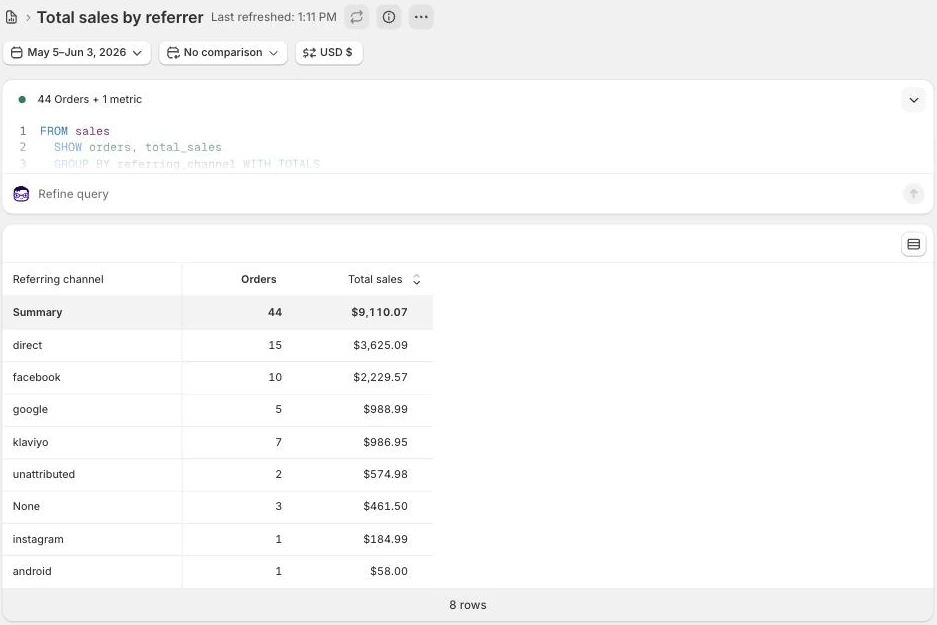
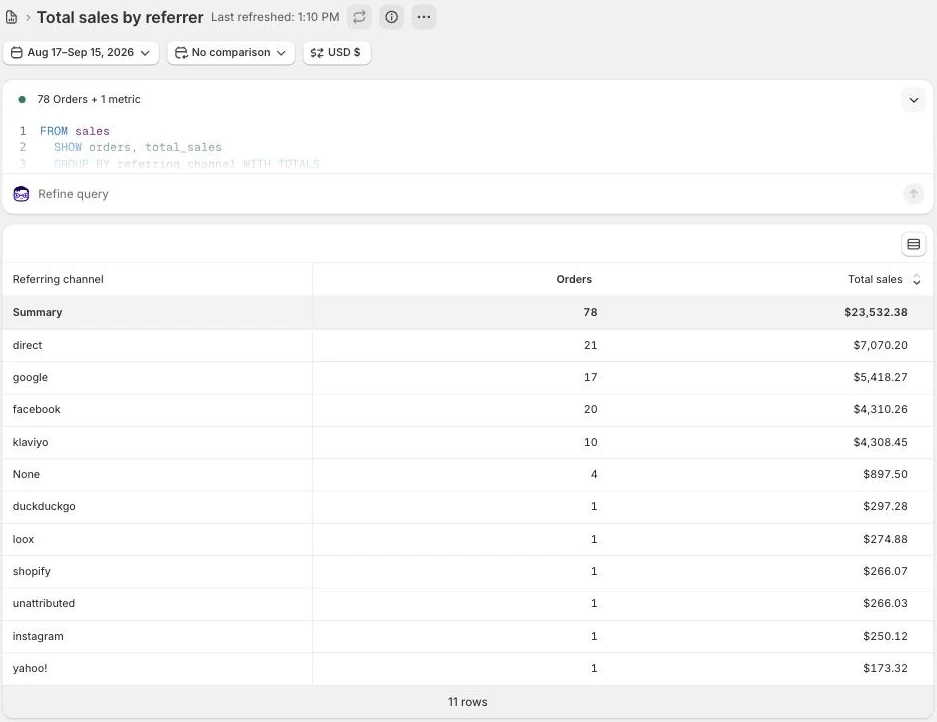
On the store in the case study, revenue from Google, meaning organic search and free listings rather than paid ads, went from $354 in the 30 days before the work began (May 5 to June 3, 2026) to $5,418 in the 30 days about three months in (August 17 to September 15, 2026). The product pages were rewritten and the best products published to Google in the same weeks, and it is one store. More in Google free listings and ecommerce SEO.
Can you really make money with Shopify?
Yes, but Shopify does not make it for you. The platform processes the orders; your products, pages, content and traffic decide how many there are.
Shopify’s pricing page says merchants have made $1.1 trillion in sales on Shopify, and that an entrepreneur makes a first sale every 26 seconds. Those are the vendor’s figures across millions of stores, not a forecast for yours.
A fairer test is a store you can check. On the one in the case study, the 30 days before the work began (May 5 to June 3, 2026) brought in $9,110. The 30 days about three months in (August 17 to September 15, 2026) brought in $23,532, by Shopify’s own reports.
Google and email went from 15% of revenue to 41%. It is one store, and its Facebook ads ran in both periods. It sold on Shopify the whole time; what changed was the traffic.
How do you decide if Shopify is worth it for your store?
Put last month’s spending next to last month’s orders, by channel. That turns is Shopify worth it into a number you can check:
Add up the platform bill. In your Shopify admin, go to Settings, then Billing, and total the subscription, app charges, shipping labels and any transaction fees.
Add the card charges. They come out of your payouts, so read them from the payouts report, not the bill.
Add the traffic you paid for. Ad spend from each ad account, plus any agency or freelancer invoices.
Open Total sales by referrer for the same month. Note the share from Google, email, social and paid channels.
Divide each cost by the revenue it supports. Platform spend by total revenue; ad spend by the revenue from paid channels.
Read the result. If the platform takes a few percent and the ads take a large share, the fix is traffic you do not pay for by the click, not a new platform.
The platform bill is small and boring, and card fees are a few percent of revenue. A growing share of orders comes from Google and email, which cost nothing per click, so the ads become a choice rather than the whole plan. You open Shopify’s reports and know which channel paid for itself.
That is when the answer to is Shopify worth it becomes an easy yes. The subscription is the cheapest employee you have, and the store keeps selling when the ad budget pauses. Leave the mix as it is, and the ad bill keeps setting your margin for you.
The proof, from one store
Straight from the case study, with the source and what it does not prove. See all five results.
Result 1 · Sales
Total sales: $9,110 to $23,532 in about 90 days
Before the work$9,110
→
About 90 days in$23,532
2.6x
Baseline: the 30 days before the work began
$9,110 in sales from 44 orders, May 5 to June 3, 2026: the 30 days before the work began on June 4, 2026. Google and email brought in 15% of it.
The work: what changed
Rewrote product names, page titles, descriptions and the text Google shows in search results around what buyers search for, with real weights (August 7 to 30). Built six city landing pages (August 1 and 2). Published the highest-value products to Google (August 24). Put welcome, abandoned cart and browse abandonment emails live (July 28) and replaced a weekly email that was not sending (September 4). Moved the Facebook budget to warm audiences (August 26).
Result: about three months in
$23,532 in sales from 78 orders, August 17 to September 15, 2026, 2.6 times the baseline. Google and email brought in 41% of it.
Evidence source
Shopify Analytics, Total sales over time and Total sales by referrer, pulled September 18, 2026.Shopify’s Total sales by referrer report, grouped by referring channel, for the 30 days before the work began (May 5 to June 3, 2026). Store name redacted.The same report for the 30 days about three months in (August 17 to September 15, 2026). Store name redacted.
What this does not prove
This compares the 30 days before the work began with the 30 days about three months in, not an average. That is why every month is in the table below. The store's largest orders are seasonal deposit orders, and one September order made up $2,080 of the result. The Facebook ads ran in both periods.
Test it on your store
In Shopify, go to Analytics, then Reports, and open Total sales over time. Take the 30 days before your last big change and compare them with your most recent 30 days.
Want a Shopify expert on your store?Work with a Shopify expert. On one store, a month of sales went from $9,110 to $23,532 in about 90 days. I work remotely with Shopify stores across the US.
Straight answers
Questions about this.
Is Shopify still worth it in 2026?
For most stores that already sell, yes. As of September 2026, Shopify's entry plan is $39 a month billed monthly or $29 billed yearly, and an online card payment through its own processor costs 2.9% plus 30 cents. Compare what you spend on traffic with the platform bill before you blame the platform.
How much does Shopify take from a $100 sale?
On the entry plan with Shopify's own payment processing, $3.20 for a standard card paid online: 2.9% of $100 plus 30 cents. Premium cards come to $3.80 and international cards $4.20. A third-party payment provider adds Shopify's 2% transaction fee, or $2, on top of that provider's own charges.
What does a Shopify store really cost each month?
The plan, card fees on every order, any paid apps, one-time costs such as a paid theme or domain, and what you spend to bring visitors. As of September 2026, the entry plan is $39 billed monthly, and card fees start at 2.9% plus 30 cents. App developers set their own prices, so list yours before you compare plans.
How much does Shopify take from a $20 sale?
On the entry plan with Shopify's own processing, 88 cents for a standard card paid online: 2.9% of $20 plus 30 cents. That is 4.4% of the order, because the fixed 30 cents weighs more on small orders. Higher tiers lower the percentage but keep the 30 cents.
What are the downsides of Shopify?
Card fees grow with revenue, third-party payment providers trigger an extra transaction fee, paid apps add monthly costs, and checkout customization is limited below Plus. The biggest downside is that Shopify brings no shoppers of its own, so the store has to earn its traffic from search, email or ads.
Is Shopify good for small business?
Yes, for a small business that sells online and wants its own store, checkout and customer list. Shopify labels its entry tier for solo entrepreneurs and Grow for small teams. It suits businesses less if sales are occasional or the products only sell where a marketplace already has the shoppers.
Which is better, Etsy or Shopify?
Etsy is cheaper to start and dearer per sale; Shopify charges a subscription and less per order. On a $100 item with free shipping, Etsy's listed fees come to $9.95 against $3.20 on Shopify's entry tier, so at $100 an order Shopify's subscription is covered after about six orders a month.
Is Shopify Plus worth it for a small business?
Usually not, unless you need something only Plus offers. As of September 2026, Shopify's pricing page lists Plus from $2,300 monthly and full checkout customization only on Plus. On card fees alone, its lower 2.25% rate would need about $760,000 of monthly online card sales to cover the gap over Advanced.
Is there a free version of Shopify?
Not for a full online store. As of September 2026, Shopify's pricing page offers a 3-day free trial, then $1 a month for 3 months on most plans. It also lists an Agentic option at $0 a month for selling only in AI channels, where you pay only when you make a sale.
Why is my Shopify bill more than $39?
Because the bill includes more than the subscription. Shopify's help center says each bill breaks down the subscription, app charges, shipping labels and third-party transaction fees, with tax charges at the bottom. Card processing charges are not on the bill, because Shopify deducts them from your payouts instead.